




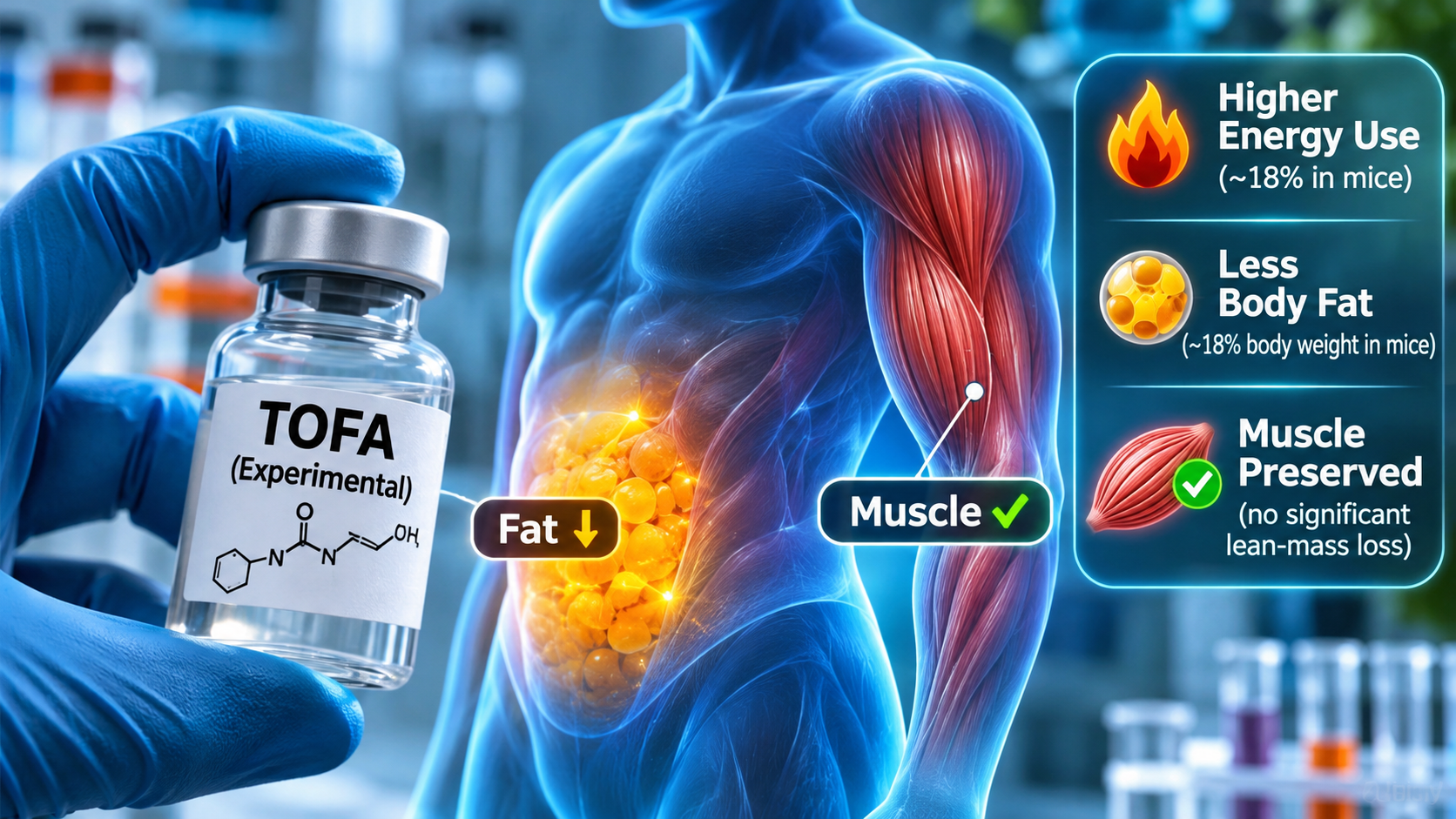
An experimental compound called TOFA increased energy use, reduced body fat, and improved blood sugar control in mice. Researchers believe its unusual mechanism could offer a new direction for future obesity treatments—but human studies are still needed.
For millions of people trying to lose weight, the goal is not simply to see a smaller number on the scale. Ideally, weight loss should reduce excess body fat while preserving the muscle needed for strength, mobility, and healthy metabolism.
That balance can be difficult to achieve. When people lose substantial amounts of weight, they often lose both fat and lean tissue.
Now, scientists at the University of California, Berkeley, have reported promising findings involving an experimental compound that appears to help mice burn more energy without substantially reducing their muscle mass.
The compound, known as 5-tetradecyloxy-2-furoic acid (TOFA), increased energy expenditure by approximately 18% under certain experimental conditions. In one obesity experiment, treated mice also lost an average of approximately 18% of their body weight over several weeks.
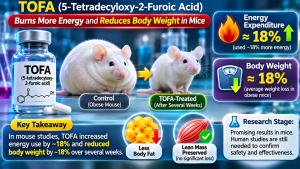
More importantly, the researchers found that much of the weight reduction came from body fat rather than lean mass.
The findings were published in the peer-reviewed journal Science Advances on August 21, 2026, and highlighted again in a November 19 research report.
However, TOFA remains an experimental compound. Its effectiveness, long-term safety, and appropriate dosage in humans have not been established.
1. Why Losing Fat Without Losing Muscle Matters
Most people think of weight loss as a reduction in total body weight. But the composition of that weight matters just as much.
The human body contains several types of tissue, including fat, muscle, bone, and organs.
When weight decreases, the loss may come from body fat, water, muscle, or a combination of these components.
Skeletal muscle is particularly important because it supports movement, posture, balance, and glucose metabolism.
Muscles also consume energy throughout the day, even when a person is resting.
Losing excessive muscle during weight reduction may contribute to weakness, decreased physical performance, and reduced functional independence, particularly among older adults.
This is one reason scientists are increasingly interested in treatments that selectively reduce fat while helping preserve muscle.
Importantly, lean mass and skeletal muscle are not exactly the same measurement. Lean mass includes water, organs, and other nonfat tissues. In the TOFA experiments, researchers measured lean mass, so the results do not establish that every aspect of muscle strength or function was preserved.
2. A Different Approach From Popular Weight-Loss Medications
Medications such as semaglutide and tirzepatide have significantly changed the treatment of obesity and type 2 diabetes.
Semaglutide is marketed under brand names including Ozempic and Wegovy, while tirzepatide is sold as Mounjaro and Zepbound.
These medications act through hormone-related pathways involved in appetite regulation, glucose control, and food intake. Tirzepatide targets both GIP and GLP-1 receptors.

By helping patients feel satisfied with less food, these drugs can produce substantial weight loss.
However, some patients experience nausea, vomiting, or other gastrointestinal side effects. Significant weight loss can also include reductions in lean body mass.
The Berkeley researchers investigated another possibility:
What if a treatment could increase the amount of energy the body uses, rather than primarily reducing the amount of food consumed?
This question led them to examine TOFA, a compound first studied decades ago for its effects on lipid metabolism.
Unlike appetite-focused therapies, TOFA produced metabolic changes in mice without a measurable reduction in food consumption.
3. What Is TOFA, and How Does It Work?
TOFA is a small molecule originally investigated in the 1970s.
Scientists already knew it could inhibit enzymes involved in producing fatty acids. The new study revealed that it also influences additional metabolic pathways.
Researchers identified two major mechanisms.
First mechanism: Reducing fat production
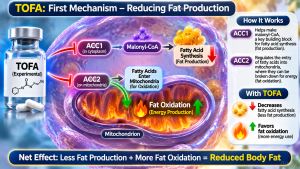
TOFA inhibits two enzymes called acetyl-CoA carboxylase 1 and 2, abbreviated ACC1 and ACC2.
These enzymes help regulate fatty acid synthesis and oxidation.
ACC1 participates in the production of malonyl-CoA, an important building block for synthesizing fatty acids.
ACC2 helps regulate the entry of fatty acids into mitochondria, where they can be broken down for energy.
By inhibiting these enzymes, TOFA can reduce fatty acid synthesis and favor fat oxidation.
Second mechanism: Activating energy-burning pathways
The Berkeley team also discovered that TOFA partially activates two receptors called PPAR-alpha and PPAR-delta.
These receptors help regulate genes involved in lipid metabolism, cellular energy use, and fatty acid oxidation.
When activated, they can encourage cells to use fatty acids as fuel.
This dual action is what makes TOFA particularly interesting.
Rather than influencing only one metabolic pathway, the compound appears to coordinate processes involved in both fat production and energy expenditure.
4. Energy Expenditure Increased by Approximately 18%
One of the most striking findings was an increase in whole-body energy expenditure.
In metabolic testing, mice receiving TOFA used approximately 18% more energy than untreated comparison mice under room-temperature and thermoneutral conditions.
Interestingly, this increase occurred without a corresponding rise in physical activity or body temperature.
The findings suggest that changes in cellular metabolism, rather than simply greater movement, contributed to the effect.
However, this does not mean that humans taking TOFA would automatically burn 18% more calories.
Human metabolism differs considerably from mouse metabolism, and the drug has not been shown to produce comparable effects in people.
The safety of deliberately increasing energy expenditure also requires careful evaluation, including possible cardiovascular and other systemic effects.
5. Obese Mice Lost Fat Without Significant Lean-Mass Loss
The researchers conducted experiments using mice that had developed obesity after consuming a high-fat diet.
During one treatment experiment, TOFA-treated animals lost an average of approximately 18% of their body weight.
Body-composition measurements indicated that the reduction came primarily from fat mass.
Researchers did not detect a statistically significant reduction in lean mass.
The mice also did not eat significantly less food than untreated animals, suggesting that appetite suppression was not responsible for the observed weight reduction.
This is an important distinction.
Two treatments might produce similar reductions in total weight while having different effects on the body’s fat and lean-tissue compartments.
Nevertheless, the experiments were relatively short, and preservation of measured lean mass does not necessarily establish protection against muscle weakness or functional decline over longer periods.
6. TOFA Also Improved Blood Sugar and Liver Fat
The findings extended beyond weight reduction.
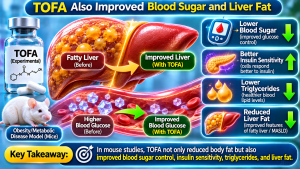
Researchers observed improvements in several markers associated with metabolic disease.
Blood glucose control: TOFA-treated mice showed improved glucose tolerance and lower fasting blood glucose levels in relevant experiments.
Insulin sensitivity: The animals demonstrated improved responses to insulin, which helps regulate the movement of glucose from the bloodstream into cells.
Triglycerides: Treatment lowered circulating triglycerides in the models studied.
Fatty liver: Researchers observed reductions in liver fat and improvements in features associated with metabolic dysfunction-associated steatotic liver disease, or MASLD.
Excess liver fat can contribute to inflammation and, in some people, progressive liver injury.
Some experimental models also showed improvements in markers of liver inflammation and fibrosis.
These findings suggest that TOFA may affect several interconnected metabolic processes rather than body weight alone.
However, improvements in mouse disease models cannot yet be interpreted as proven treatments for human diabetes, fatty liver disease, or obesity.
7. Why Researchers Are Particularly Interested in the Dual Mechanism
Some drugs that inhibit ACC enzymes have previously been investigated for fatty liver disease and other metabolic conditions.
Unfortunately, several have produced an undesirable rise in blood triglycerides.
Elevated triglycerides can be associated with increased cardiovascular risk, particularly when accompanied by other metabolic abnormalities.
TOFA appears to behave differently.
In the Berkeley experiments, it reduced liver fat without causing the triglyceride increases observed with certain other ACC inhibitors.
Researchers suspect its additional activation of PPAR-alpha and PPAR-delta may help explain this difference.
They also tested whether using separate compounds to inhibit fat production and increase energy expenditure could produce similar results.
The combined separate treatments did not reproduce all the metabolic benefits seen with TOFA itself.
This suggests that the particular combination of biological activities within one molecule may be important.
Scientists will need further experiments to clarify the precise mechanisms and determine whether these benefits can be reproduced safely in other species.
8. Could TOFA Work Together With Ozempic or Wegovy?
Another intriguing part of the study involved combining TOFA with existing weight-loss medicines.
Researchers tested TOFA alongside semaglutide or tirzepatide in obese mice.
The combination treatments produced greater improvements in several metabolic measures than either experimental treatment alone.
These included reductions in body weight, improvements in glucose regulation, and decreases in triglyceride levels.
The results suggest that the two strategies may complement each other.
Semaglutide and tirzepatide affect appetite and nutrient-related hormonal signaling, while TOFA appears to increase energy expenditure and alter lipid metabolism.
In theory, a future treatment could target both sides of energy balance.
But there is an important caution: No clinical trial has established that combining TOFA with semaglutide or tirzepatide is safe or effective in humans.
TOFA should not be considered an available add-on treatment or used experimentally outside properly supervised research.
9. Could This Lead to Better Treatments for Fatty Liver and Diabetes?
Obesity, type 2 diabetes, abnormal blood lipids, and fatty liver disease frequently occur together.
One reason is that they share underlying metabolic pathways involving insulin resistance, excess energy storage, and altered fat metabolism.
A medication that beneficially influences several pathways could eventually become valuable for people with overlapping metabolic conditions.
Researchers are particularly interested in TOFA because it appears to influence fat synthesis, fatty acid oxidation, and glucose metabolism at the same time.
However, translating these findings into practical medicine will require considerably more evidence.
Future research must determine whether the compound produces meaningful clinical benefits at doses that humans can tolerate safely.
10. What Are the Limitations of the Study?
Despite the promising results, there are several important limitations.
Animal research: The major weight-loss and metabolic findings came from mice. Laboratory animal results do not reliably predict human treatment outcomes.
Short treatment periods: Many experiments lasted only several weeks. Long-term effects and potential toxicities remain uncertain.
Muscle assessment: Researchers measured lean body mass, but the reported findings do not establish long-term preservation of human muscle strength, muscle quality, or physical function.
Dosing and safety: Effective and safe human doses have not been determined. More extensive toxicology and safety studies are necessary.
Commercial interests: Some researchers involved in the study have financial interests in ReRx Therapeutics, a company working to advance the compound. This relationship was disclosed in the research reporting and is relevant when interpreting the findings.
The researchers themselves acknowledged the need for further animal and human investigations.
As of this report, TOFA should be viewed as a promising research candidate—not an approved weight-loss medication.
11. What Can People Do Today to Preserve Muscle During Weight Loss?
While the search for better obesity medications continues, there are already evidence-based strategies for supporting muscle health during weight management.
Regular resistance exercise can help stimulate muscle maintenance and improve strength.
Adequate dietary protein provides the amino acids needed for muscle repair and maintenance.
A balanced diet that supplies sufficient vitamins, minerals, and overall energy also supports normal physiological function.
For people using prescription weight-loss medications, monitoring nutrition, body composition when appropriate, and physical function may be helpful.
Older adults and individuals with chronic diseases may benefit from individualized exercise and nutrition advice.
These approaches cannot guarantee the prevention of muscle loss, but they remain important components of healthy weight management.
12. The Future of Weight-Loss Medicine May Involve More Than Appetite Control
The Berkeley findings highlight a broader shift in obesity research.
Scientists are not only trying to help people eat less. They are also studying how the body regulates energy expenditure, stores fat, uses glucose, and maintains muscle.
TOFA offers an intriguing example of this approach.
By simultaneously influencing fat synthesis and energy-burning pathways, the compound produced encouraging results in several mouse models of metabolic disease.
Whether those effects can be replicated safely in humans is still unknown.
If future research confirms its benefits, the strategy could eventually complement existing treatments and offer new options for patients with obesity and related metabolic disorders.
For now, the most important message is not that scientists have discovered a miracle weight-loss drug.
It is that researchers may have identified another biological route toward reducing excess fat while preserving lean tissue.
That could be an important step in developing safer and more effective approaches to metabolic health.
Research Sources
- Lee, J. Y., et al. (2026). A multi-functional oral small molecule targeting energy and lipid metabolism to treat obesity and related metabolic disorders. Science Advances, 12(34), eaed3119.
https://doi.org/10.1126/sciadv.aed3119 - University of California, Berkeley. (August 21, 2026). A promising new weight loss and diabetes treatment helps burn fat while keeping muscle.
https://news.berkeley.edu/2026/08/21/a-promising-new-weight-loss-and-diabetes-treatment-helps-burn-fat-while-keeping-muscle/ - ScienceDaily. (November 19, 2026). Experimental compound burns fat without sacrificing muscle.
https://www.sciencedaily.com/releases/2026/11/261118073918.htm
Medical Disclaimer
This article is provided for educational and informational purposes only. It does not constitute medical advice or a recommendation to use experimental treatments. TOFA has not been established as safe or effective for treating obesity or other metabolic diseases in humans. Consult a qualified healthcare professional before making changes to prescribed medications or weight-management treatments.