
VIETECHO NEWS | TECH/SCIENCE | OCTOBER 8, 2026
For decades, flying cars have belonged to the world of science-fiction movies, futuristic illustrations, and ambitious engineering experiments.
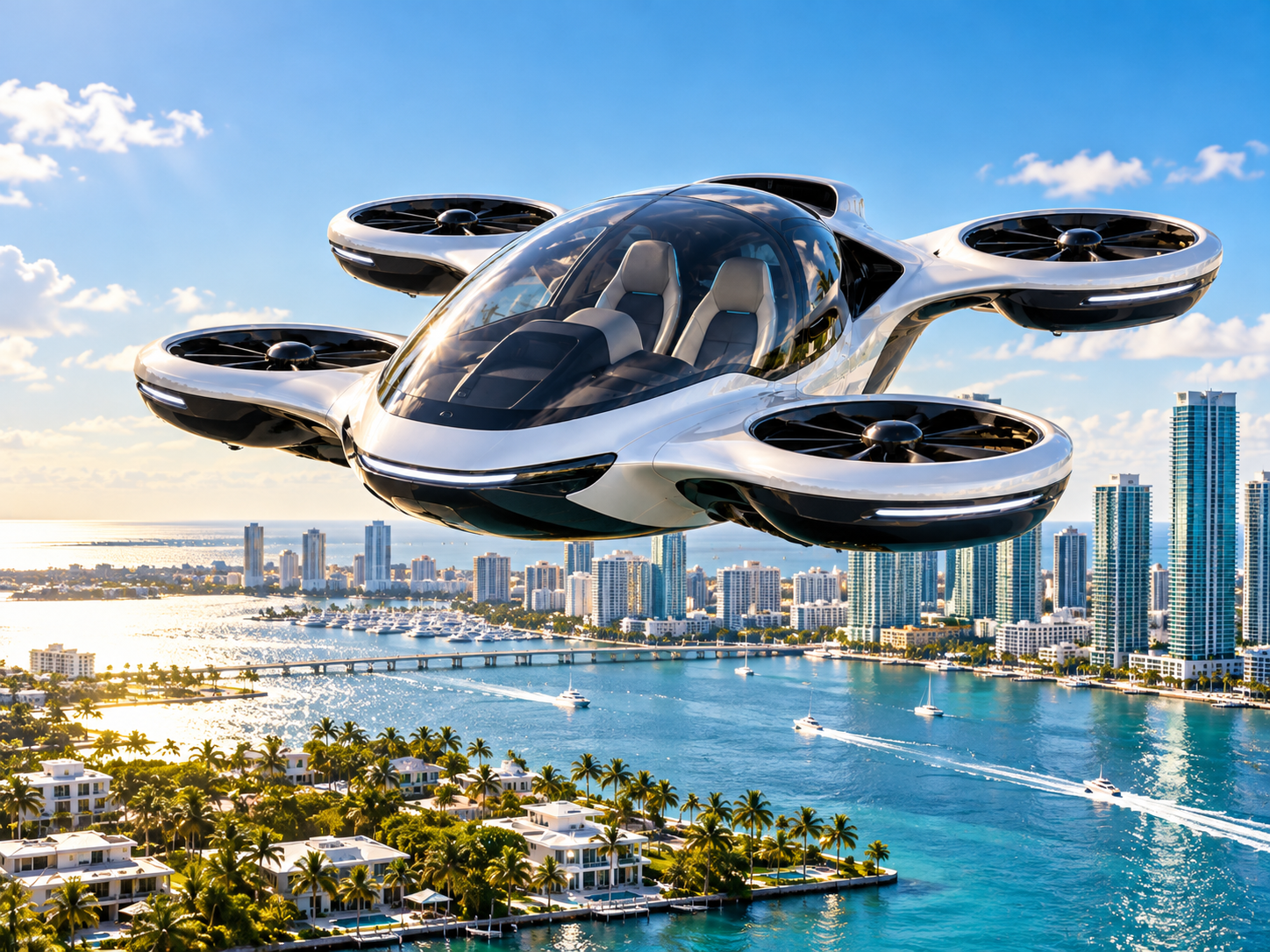
Now, a Florida-based aerospace company is working to bring personal electric flight closer to reality.
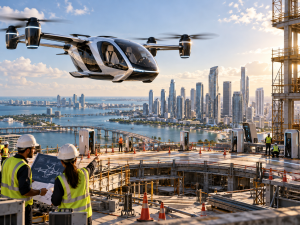
Doroni Aerospace is developing the H1-X, a two-seat electric vertical takeoff and landing aircraft, commonly known as an eVTOL.
The company’s vision is to create a personal aircraft that can take off vertically without a conventional runway, potentially allowing owners to travel through the air from suitable private locations where regulations permit.
But how close are we to seeing flying vehicles become part of everyday transportation?
Meet the Doroni H1-X
The H1-X is designed as a compact personal electric aircraft capable of transporting two occupants.
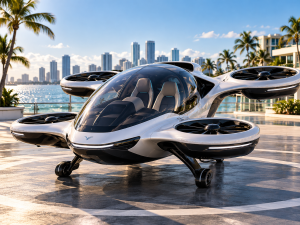
Unlike traditional airplanes, which require long runways, electric vertical takeoff and landing aircraft use electrically powered propulsion systems to lift off vertically.
Doroni’s proposed aircraft incorporates multiple ducted fans, electric motors, computerized flight controls, and an advanced digital assistance system.
The company intends to make flying more intuitive and accessible than conventional aircraft operation.
One of its goals is to develop an aircraft compact enough to fit inside a standard two-car garage.
However, the H1-X remains in development and is not yet a certified consumer aircraft.
A Flying Vehicle Designed Around Safety
Doroni says safety and operational simplicity are central to the H1-X design.
Several proposed technologies distinguish the aircraft from traditional helicopters and small airplanes.
Multiple Electric Motors
The H1-X design incorporates ten independent electric motors to provide propulsion redundancy.
This architecture is intended to improve resilience if certain components malfunction.
However, the aircraft’s complete safety capabilities must still be demonstrated through testing and regulatory review.
Enclosed Ducted Fans
Unlike helicopters with large exposed rotor blades, the H1-X uses enclosed propulsion fans.
The design aims to improve protection around rotating components while potentially reducing noise.
Emergency Parachute System
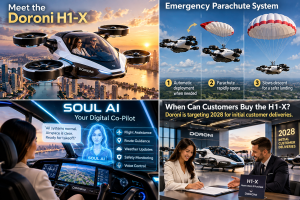
Doroni plans to equip the aircraft with a whole-aircraft emergency parachute as an additional layer of protection.
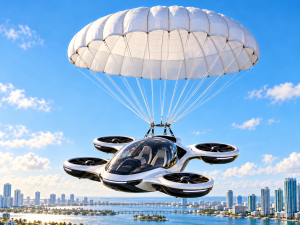
Such systems are designed for specific emergency scenarios and do not eliminate the risks associated with aviation.
AI-Assisted Flight Controls
Another major feature is SOUL AI, Doroni’s proposed digital co-pilot.

The system is intended to assist with flight controls, stability, and pilot interaction.
Although artificial intelligence could simplify certain flying tasks, it does not automatically make the H1-X a fully autonomous aircraft.
Operators would still need to comply with applicable aviation training, certification, and operating requirements.
Has Doroni Actually Flown a Flying Car?
Doroni reports that its earlier experimental aircraft have completed more than 70 test flights, including piloted demonstrations conducted under FAA authorization.
These flights represent important milestones in evaluating the company’s propulsion and flight-control technologies.
However, there is an important distinction between those experimental aircraft and the H1-X intended for consumers.
The company unveiled a full-scale H1-X engineering model in March 2026.
The engineering model demonstrates the proposed aircraft’s physical design and systems integration, but it is not proof that the production-intended H1-X has completed flight testing or certification.
Doroni’s development roadmap calls for additional engineering work in 2026 and more extensive testing in 2027.
A Regulatory Breakthrough for Personal Aviation
Aviation regulations have traditionally created substantial challenges for developers of new aircraft categories.
However, the Federal Aviation Administration’s Modernization of Special Airworthiness Certification framework, known as MOSAIC, provides an expanded regulatory framework for qualifying light-sport aircraft.
The changes create potential opportunities for certain powered-lift aircraft, including designs that can take off and land vertically.
Doroni intends to pursue a light-sport aircraft certification pathway for the H1-X.
The company believes qualifying operators may eventually be able to use a Sport Pilot Certificate rather than following the training pathway required for some conventional aircraft.
Nevertheless, regulatory eligibility and aircraft certification are separate matters.
Doroni must demonstrate that its aircraft meets applicable safety and airworthiness requirements before customer operations can begin.
When Can Customers Buy the H1-X?
Doroni is targeting 2028 for initial customer deliveries.
Its proposed schedule includes:
- 2026: Finalize engineering, propulsion, control systems, and prototype readiness.
- 2027: Conduct additional flight testing, validate performance, and advance the FAA approval process.
- 2028: Begin manufacturing and deliver the first customer aircraft, subject to successful development and regulatory approval.
The company has also reported substantial interest from prospective buyers.
However, reservations are not the same as completed aircraft sales.
In its September 2026 securities filing, Doroni acknowledged that it remained a pre-revenue company without established commercial production operations.
That means the proposed delivery timeline is an ambitious business target rather than a guaranteed launch date.
Could Flying Cars Change Everyday Transportation?
If personal electric aircraft become affordable, reliable, and widely available, they could create new possibilities for transportation.
Potential applications include:
Personal travel: Owners might eventually use suitable aircraft for shorter regional journeys where roads are congested.
Emergency response: Certain electric aircraft technologies could support specialized rescue, medical, or emergency operations.
Remote communities: Vertical takeoff aircraft might improve access to locations with limited transportation infrastructure.
Recreational aviation: Personal electric flight could attract aviation enthusiasts seeking a different flying experience.
However, widespread adoption would require much more than successful aircraft engineering.
Communities would need appropriate landing areas, charging facilities, safety regulations, airspace coordination, and emergency response procedures.
Weather restrictions, battery endurance, operating costs, insurance, and pilot training would also affect practicality.
It is also important to distinguish a flying car from an electric aircraft.
Despite the popular nickname, the H1-X is being developed primarily as a personal flying vehicle rather than a conventional automobile that can drive on public roads.
The Future Is Still Being Built
Doroni Aerospace is among several companies pursuing a future in which electric vertical flight becomes more accessible.
Its earlier experimental flights, development of the H1-X, and changes in aviation regulations represent steps toward that goal.
Yet major challenges remain before personal electric aircraft can enter widespread consumer use.
The company must still validate the technology, obtain required approvals, and establish reliable manufacturing operations.
If Doroni successfully achieves its goals, the H1-X could become part of a new generation of personal aviation vehicles.
For now, the flying-car dream is moving beyond science fiction—but the path from prototype to everyday transportation is still under construction.
VietEcho Tech/Science — Exploring the innovations shaping tomorrow.