
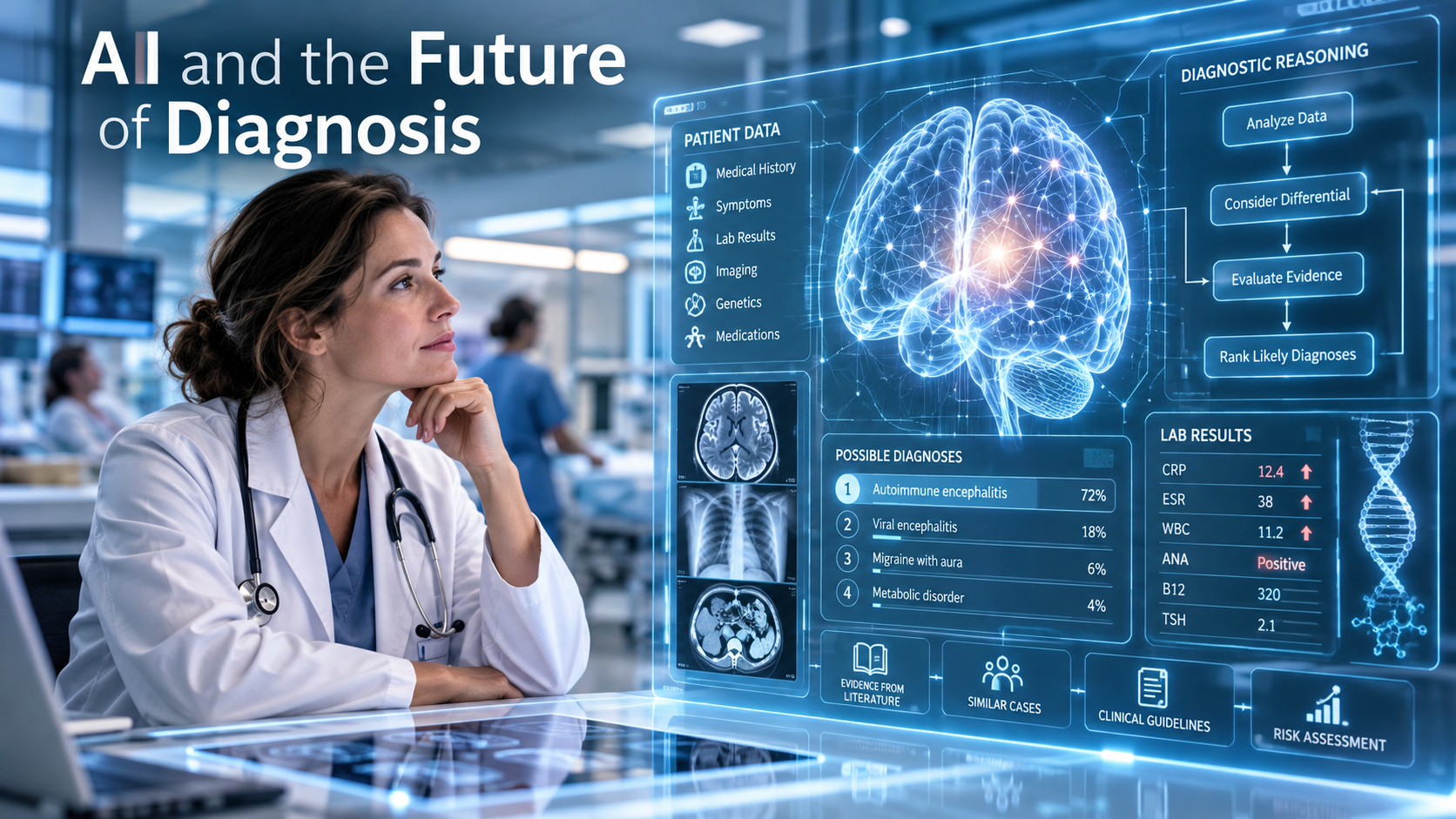
Groundbreaking research published in Science suggests artificial intelligence could transform medical diagnosis, potentially helping physicians identify difficult diseases more accurately while reducing unnecessary testing.
Artificial intelligence has reached another significant milestone in healthcare. A new study published in the prestigious journal Science on October 22, 2026, found that Microsoft’s advanced diagnostic AI system achieved approximately 83% accuracy in complex medical cases, compared with 36% among participating physicians who had access to medical reference materials.
The findings raise an intriguing question: Could artificial intelligence eventually help doctors diagnose diseases that might otherwise go undetected?
The technology, called the Microsoft AI Diagnostic Orchestrator (MAI-DxO), approaches medical problems through a process resembling clinical reasoning. Rather than immediately offering a diagnosis, it collects information, considers competing explanations, selects relevant tests, and continuously revises its conclusions.
Although the findings are promising, researchers emphasize that the system has not yet demonstrated equivalent performance in everyday patient care.
An AI That Thinks Through Medical Problems Step by Step
Traditional medical AI evaluations often present a complete patient history, laboratory findings, and imaging results before asking the system to identify a diagnosis.
However, actual medical practice rarely works that way.
When patients first arrive at a clinic or emergency department, doctors may know little more than their symptoms. Physicians must ask questions, perform examinations, order appropriate tests, and interpret new information before making a diagnosis.
Microsoft designed MAI-DxO to follow a similar process.
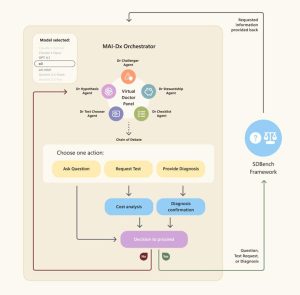
The system uses multiple simulated clinical experts that evaluate possible diagnoses, challenge one another’s conclusions, and recommend additional information when needed.
For example, a patient presenting with unexplained fatigue, fever, and abdominal discomfort could have numerous possible conditions.
Instead of immediately choosing one disease, the AI might investigate the patient’s medical history, identify important symptoms, request laboratory studies, and adjust its differential diagnosis as findings become available.
The objective is not simply to reach the correct answer, but to determine which diagnostic steps are most informative and cost-effective.
The Results: AI Significantly Outperformed Participating Physicians
Researchers evaluated MAI-DxO using two groups of medical cases.
The first contained 304 particularly challenging cases drawn from The New England Journal of Medicine. These included complex diagnostic problems selected for their educational value.
The second included 325 emergency-department cases reconstructed from historical medical records.
Diagnostic Accuracy Comparison
| Evaluation | Microsoft AI | Physicians |
|---|---|---|
| 304 complex NEJM cases | 83.2% | 36.1% with references |
| Complex cases without physician reference materials | 83.2% | 22.3% |
| 325 emergency-department cases | 80.3% | 46.8% |
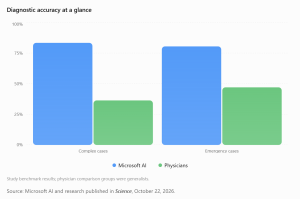
In the challenging NEJM cases, the AI achieved more than twice the accuracy of participating generalist physicians using textbooks and online resources.
In the emergency-department cases, its accuracy was approximately 1.7 times that of the physician comparison group.
These differences were substantial, although the physician comparisons involved a limited set of participants and evaluated cases rather than actual bedside care.
Could AI Also Reduce Medical Costs?
One of the study’s most interesting findings involved the potential to reduce unnecessary diagnostic testing.
Medical investigations can become expensive, particularly when patients undergo multiple laboratory studies, imaging examinations, and specialized procedures.
Researchers examined whether the AI could balance diagnostic accuracy with the estimated costs of its investigations.
In one cost-constrained configuration involving the complex NEJM cases, MAI-DxO maintained approximately 81% diagnostic accuracy while generating estimated testing costs of about $2,241 per case.
By comparison, participating physicians using reference resources generated estimated costs averaging approximately $4,725 per case.
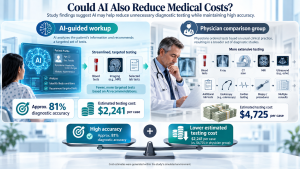
These figures were calculated within the study’s simulated environment. They do not represent verified savings in actual hospital billing or patient care.
Nevertheless, the findings suggest that AI could eventually help healthcare teams choose more efficient diagnostic pathways.
Does This Mean AI Is Better Than Doctors?
Not necessarily.
The study evaluated artificial intelligence and physicians under specific research conditions.
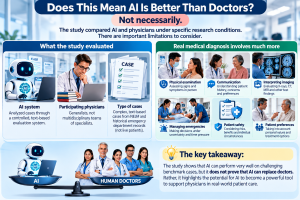
Participating doctors were generalists rather than multidisciplinary teams of specialists. The cases were presented through a controlled, text-based evaluation system rather than live patient encounters.
Actual medical diagnosis involves far more than interpreting written information.
Physicians must assess physical findings, recognize subtle clinical changes, communicate with patients and families, interpret imaging and other results, manage emergencies, and make decisions under uncertainty.
They must also consider a patient’s preferences, circumstances, and treatment options.
Furthermore, identifying the correct diagnosis is only one component of delivering safe, effective medical care.
An AI system that performs exceptionally well on a benchmark may still make dangerous mistakes in clinical practice.
For these reasons, the research does not establish that AI can replace physicians.
The Next Step: Testing AI in Real Hospitals
Microsoft is preparing to investigate how its technology performs outside simulated medical cases.
The company announced a research partnership with Beth Israel Deaconess Medical Center in Boston to evaluate the system in clinical environments.
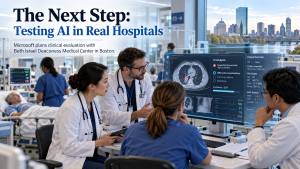
The planned work includes directly engaging patients and comparing AI-generated clinical assessments with physicians’ independent evaluations.
Such studies could provide crucial information about reliability, safety, workflow integration, and the situations in which AI assistance may be beneficial or harmful.
Independent research and real-world clinical validation will be essential before the technology can be widely adopted.
The Future of Medicine: Doctors Working Alongside AI
Perhaps the most important implication of Microsoft’s research is not a competition between humans and machines.
Instead, it is the possibility of bringing powerful diagnostic assistance to physicians who face increasing clinical complexity.
Modern medicine involves thousands of diseases, continuously evolving research, expanding treatment options, and enormous amounts of medical information.
No individual physician can remember every rare presentation or every newly published study.
Properly validated AI systems could potentially help identify overlooked diagnoses, recommend appropriate investigations, and provide another perspective when cases are unusually difficult.
For patients, this might eventually translate into earlier diagnoses, fewer unnecessary tests, and more timely treatment.
However, those potential benefits remain to be demonstrated in clinical practice.
The central question is no longer simply whether AI can answer difficult medical questions. It is whether AI can help healthcare professionals make better, safer decisions for real patients.
Microsoft’s new research represents a promising step toward that possibility, but the path from laboratory success to trustworthy medical care remains an important challenge.
Sources
- Microsoft AI, October 22, 2026: Building Medical Superintelligence
- Science, October 22, 2026: Research paper — DOI: 10.1126/science.aeh7930
- Becker’s Hospital Review, October 2026: Microsoft AI diagnostic tool tops generalist physicians