
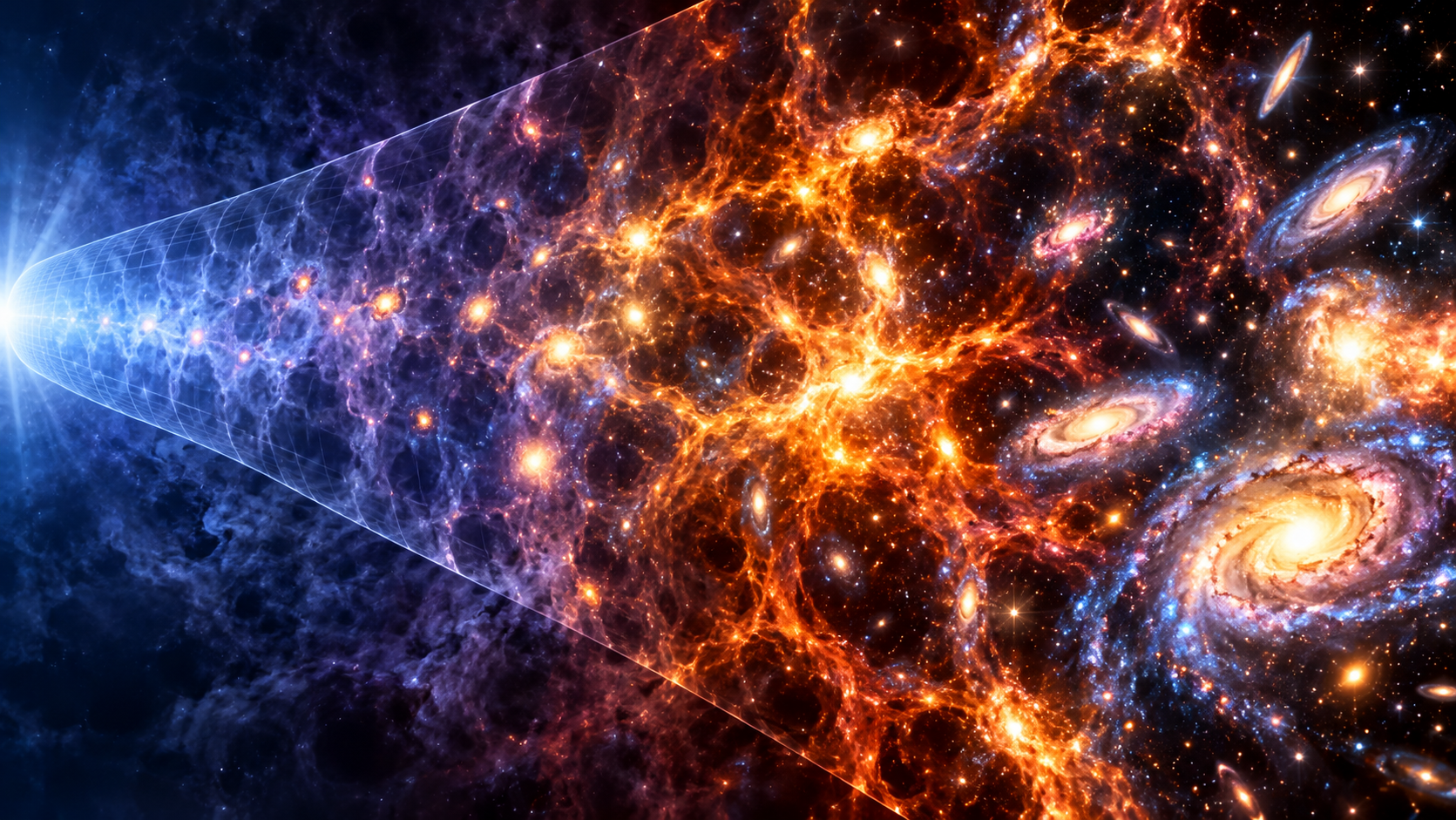
What did the universe look like before the first stars and galaxies formed? Scientists have created an extraordinary computer simulation that allows us to explore nearly two billion years of cosmic history—and the results are spectacular.
Imagine traveling backward in time.
You pass the birth of Earth, the formation of our Sun, and the creation of the Milky Way’s earliest stars.
You continue traveling billions of years into the past until you reach a mysterious period when the universe was young, dark, and almost unrecognizable.
Now imagine watching that ancient universe come alive as enormous clouds of gas gather, stars begin to shine, and the first galaxies gradually emerge.
It sounds like science fiction.
But scientists have developed a remarkable computer simulation that makes such a journey possible—at least virtually.
The project, called Lumina, is one of the largest and most detailed simulations of the early universe ever created.
Developed by an international team of researchers, including scientists from the Center for Astrophysics | Harvard & Smithsonian and the Massachusetts Institute of Technology (MIT), Lumina reconstructs nearly two billion years of cosmic evolution.
The findings were published in October 2026 in the scientific journal Monthly Notices of the Royal Astronomical Society.
What Did the Universe Look Like Before the First Stars?
Scientists estimate that the universe began approximately 13.8 billion years ago with the Big Bang.
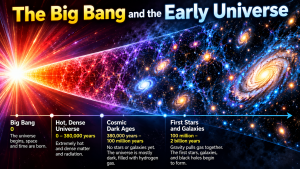
But the Big Bang was not an ordinary explosion spreading debris through empty space. It marked the beginning of the expansion of the universe itself.
In its earliest stages, the universe was extraordinarily hot and dense.
As it expanded, it cooled.
Eventually, about 380,000 years after the Big Bang, electrons combined with atomic nuclei, allowing neutral atoms to form.
The universe became transparent to much of the radiation left over from its earliest history.
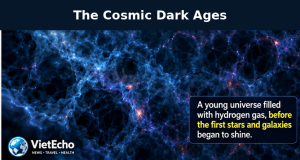
However, there were not yet stars and galaxies shining across space as we see today.
Astronomers refer to the period before the first luminous objects transformed the universe as the cosmic dark ages.
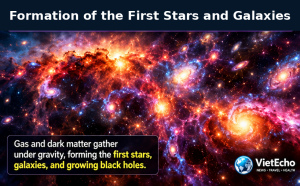
But darkness did not last forever.
Gravity gradually pulled matter into denser regions.
Gas gathered within structures dominated by an invisible substance called dark matter.
Eventually, the first stars formed, followed by increasingly complex galaxies.
Scientists have long wanted to understand exactly how these enormous transformations occurred.
Now Lumina offers a powerful new way to investigate them.
A Virtual Universe Measuring 1.5 Billion Light-Years Across
The scale of Lumina is almost impossible to imagine.
The scientists created a simulated region of space roughly 1.5 to 1.6 billion light-years wide.
What does that mean?
A light-year is the distance light travels in one year—about 5.9 trillion miles.
Even traveling at the speed of light, it would take more than a billion years to cross the simulated region.
And Lumina does not simply show a static picture.
It models how dark matter, ordinary gas, stars, galaxies, and radiation interact and change over time.
The simulation follows cosmic history beginning approximately 45 million years after the Big Bang and continuing through roughly the first two billion years.
Researchers can examine enormous structures spanning millions of light-years, then zoom inward to investigate individual developing galaxies.
Imagine Google Earth, except instead of zooming from a planet to your neighborhood, you zoom from a vast section of the universe to a single galaxy.
That’s one way to understand what makes Lumina so impressive.
The Supercomputer Behind This Extraordinary Achievement
Creating a virtual universe on such an enormous scale required extraordinary computing power.
The researchers used Frontier, a powerful supercomputer located at Oak Ridge National Laboratory in Tennessee.
At peak scale, their calculations involved approximately:
- 15,000 graphics processing units, or GPUs.
- Computing resources equivalent to more than 100,000 CPU cores.
- Roughly half a trillion simulated elements representing dark matter particles and gas cells.
A GPU is a specialized processor commonly used for graphics, video games, artificial intelligence, and complex scientific calculations.
For Lumina, thousands of these processors worked together to calculate how matter and radiation behaved across enormous distances and billions of years.
The challenge was not simply making the simulation large.
Scientists also needed enough detail to investigate individual galaxies while simultaneously following the development of vast cosmic structures.
That combination of enormous scale and fine detail is one of Lumina’s most important achievements.
Scientists Can Watch the Universe Emerge From Darkness
One of the most fascinating aspects of Lumina is that scientists can visualize how the early universe changed.
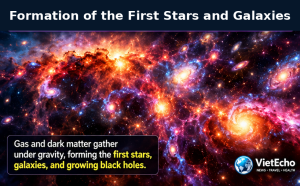
As the simulation progresses, gravity pulls gas and dark matter together.
Dense structures form.
Stars begin to shine inside galaxies.
Radiation from these stars spreads outward, changing the surrounding gas.
This transformation helped end the cosmic dark ages.
Here’s a simple way to imagine it.
Picture a vast, dark landscape covered in fog.
At first, almost nothing is visible.
Then small lights begin appearing in different locations.
Over time, more lights turn on, growing into bright clusters.
The surrounding fog gradually changes, revealing an increasingly complex landscape.
Something conceptually similar happened in the early universe.
As stars and galaxies produced energetic radiation, that radiation changed the state of hydrogen gas throughout space.
Scientists call this process reionization.

Lumina follows this transformation, along with another major process involving helium gas.
The simulation suggests that early stars and galaxies played a major role in hydrogen reionization, while energetic radiation associated with growing supermassive black holes was important for helium reionization.
Together, these processes helped shape the universe we observe today.
What Is Dark Matter, and Why Is It Important?
Another important ingredient in Lumina is dark matter.
Unlike ordinary matter, which makes up stars, planets, trees, and human beings, dark matter does not emit or absorb light in the usual detectable way.
Scientists cannot photograph dark matter directly.
However, its gravitational effects provide strong evidence that it exists.
Think of an invisible framework supporting a giant building.
You may not see the framework, but it helps determine where the visible parts of the structure are located.
Dark matter plays a somewhat similar role in cosmic structure formation.
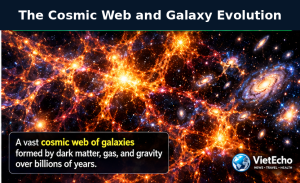
Its gravity helps pull ordinary matter into enormous networks of filaments and clusters.
These structures form what astronomers call the cosmic web.
Lumina allows researchers to follow how this invisible framework influenced the growth of the earliest galaxies.
Why NASA’s James Webb Space Telescope Matters
The simulation arrives at an exciting time for astronomy.
NASA’s James Webb Space Telescope has been observing exceptionally distant galaxies, allowing scientists to investigate the universe when it was much younger.
Because light takes time to travel, looking at extremely distant galaxies is also a way of looking into the past.
Some of the light reaching our telescopes today began its journey more than 13 billion years ago.
But astronomical observations show only the light that actually reaches us.
A computer simulation allows scientists to investigate what might have happened between those observations.
This creates an important scientific partnership.
Telescopes show astronomers evidence of what happened. Simulations help them test explanations for how it happened.
Scientists can compare Lumina’s predictions with observations from James Webb and other powerful telescopes.
If the simulated galaxies resemble real observations, that supports the physical models used in the calculations.
If important differences appear, researchers may need to revise their understanding of early cosmic history.
Lumina could also help astronomers prepare for observations from NASA’s Nancy Grace Roman Space Telescope.
A North Texas Connection to the Discovery
There is also a connection to Texas.
Aaron Smith, an assistant professor of physics at the University of Texas at Dallas, is among the researchers who contributed to the Lumina project.
His work is part of an international collaboration involving scientists from institutions in the United States, Germany, Canada, and elsewhere.
This collaboration illustrates how modern scientific discoveries increasingly depend on expertise from many fields, including astrophysics, mathematics, and advanced computing.
Did Scientists Actually Recreate the Big Bang?
Not literally.
Despite headlines about recreating the universe, scientists did not produce a new physical universe or recreate the Big Bang inside a laboratory.
Lumina is a sophisticated mathematical model running on supercomputers.
It begins tens of millions of years after the Big Bang, using initial conditions based on established scientific theories.
The computer then calculates how matter and radiation would evolve under those assumptions.
Its images and videos are scientific visualizations—not photographs of the ancient universe.
Nevertheless, the simulation provides researchers with a remarkable tool for investigating cosmic history.
What Could Scientists Discover Next?
The Lumina team hopes to use the simulation to investigate several major questions.
How did the earliest galaxies grow?
How did gas move between galaxies?
How did the first supermassive black holes influence their surroundings?
Why did some regions form stars much more rapidly than others?
And perhaps most intriguingly, do our current theories accurately describe how the early universe evolved?
By comparing Lumina with astronomical observations, scientists may discover where existing explanations need improvement.
The project also demonstrates how advances in supercomputing are transforming astronomy.
Instead of studying the universe only through telescope images and mathematical equations, researchers can now explore detailed virtual models of cosmic history.
A Remarkable Window Into Our Cosmic Past
For thousands of years, humans have looked at the night sky and wondered where everything came from.
How did the first stars appear?
How did enormous galaxies form?
How did a nearly featureless early universe become the extraordinary cosmos filled with stars, planets, and galaxies that we see today?
Lumina does not answer every question.
But it provides one of the most detailed opportunities yet to explore the universe’s early development.
And as telescopes grow more powerful and supercomputers become more capable, scientists will be able to test these models against increasingly detailed observations.
We cannot physically travel billions of years into the past. But with modern science, we can build a virtual universe and investigate how the cosmos may have evolved.
Perhaps the most extraordinary part is that everything we know—our Sun, Earth, oceans, and even ourselves—emerged from a universe whose earliest history scientists are only beginning to reconstruct in such remarkable detail.
Sources
Original research: Zier, O., et al. (2026). “Introducing the lumina project: large-volume radiation-hydrodynamic simulations of the epochs of hydrogen and helium reionization.” Monthly Notices of the Royal Astronomical Society, 552(4).
DOI: https://doi.org/10.1093/mnras/stag1469
MIT News: https://news.mit.edu/2026/watch-universe-emerge-from-dark-ages-with-lumina-1026
ScienceDaily: https://www.sciencedaily.com/releases/2026/10/261026225600.htm
Official simulation project: https://lumina-simulation.com/