

A fascinating discovery about rare brain cells could help explain why some older adults retain their memory even when their brains show signs of Alzheimer’s disease.
Imagine being 85 years old, remembering your grandchildren’s birthdays, enjoying conversations, reading books, and living independently.
Now imagine doctors examining your brain and discovering something extraordinary: it contains the physical changes associated with Alzheimer’s disease, yet you never experienced dementia.
How is that possible?
Scientists in the Netherlands believe they may have uncovered an important piece of this mystery.
A study published in the scientific journal Cell Stem Cell suggests that certain immature brain cells may help explain why some people maintain their memory and thinking abilities despite Alzheimer’s-related damage.
The discovery could eventually open new directions for protecting the aging brain.
The Mystery of People Who Never Develop Dementia
Alzheimer’s disease is a leading cause of dementia, affecting millions of families worldwide.
The disease is associated with abnormal protein buildup, damage to brain cells, and the gradual breakdown of connections involved in memory and thinking.
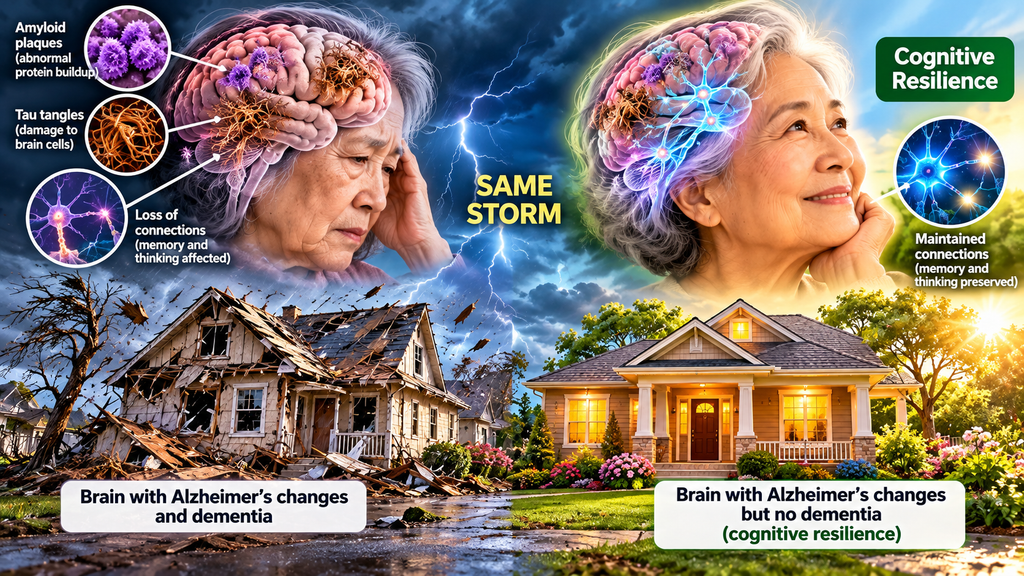
Yet not everyone with Alzheimer’s-related changes in the brain develops noticeable memory problems.
Some people remain mentally sharp despite considerable evidence of disease.
Scientists call this remarkable ability cognitive resilience.
Think of two houses exposed to the same powerful storm. One suffers extensive damage, while the other remains standing.
Researchers want to understand what makes certain brains more resistant to damage.
Scientists Examined Brains From Older Adults
Researchers at the Netherlands Institute for Neuroscience studied donated human brain tissue from three groups:
- People without detectable brain disease.
- People who developed Alzheimer’s dementia.
- People whose brains showed Alzheimer’s-related damage but who remained mentally healthy.
The scientists focused on the hippocampus, an area of the brain essential for learning and memory.
They searched for a rare type of cell known as an immature neuron.
Neurons are nerve cells that help us think, remember, learn, and communicate information throughout the brain.
Immature neurons have characteristics associated with cells that have not yet fully developed.
Researchers wondered whether these unusual cells could help explain why some older brains remain healthier than others.
A Surprising Discovery in People Over 80
The scientists found immature neurons in all three groups, including people whose average age was over 80.
That alone was intriguing.
But the researchers uncovered something even more interesting.
They initially expected people who resisted Alzheimer’s symptoms to have many more immature neurons than people who developed dementia.
Instead, the difference in cell numbers was relatively small.
The major distinction appeared to involve how the cells behaved, rather than simply how many were present.
In people who remained mentally sharp, these cells showed stronger activity in biological processes associated with survival and protection against damage.
They also showed lower activity in processes linked to inflammation and cell death.
This suggests that some brains may possess protective responses that help them tolerate disease-related changes.
Think of the Brain as a Garden
Imagine your brain as a beautiful garden.

Over time, some plants become weaker, and parts of the garden begin to deteriorate.
One way to restore the garden would be to grow new plants.
But what if certain existing plants could help protect the surrounding soil and keep the rest of the garden healthy?
Scientists suspect that immature neurons might play a somewhat similar role.
Rather than simply replacing damaged brain cells, they may help create a healthier environment for neighboring cells.
That could help existing brain networks continue functioning even when Alzheimer’s-related damage is present.
However, this remains a possibility rather than a proven mechanism.
Does This Mean the Brain Can Grow New Cells at Any Age?
Not necessarily.
The discovery of immature neurons in older adults does not prove that their brains are continuously producing new nerve cells.
Scientists are still debating how much new neuron formation occurs in the aging human brain.
The researchers also cannot yet confirm whether these immature neurons directly protect against dementia.
The study identified important differences in cellular activity, but additional experiments are needed to determine whether those differences cause greater resistance to Alzheimer’s symptoms.
Nevertheless, the findings offer an intriguing direction for future research.
A New Way to Think About Alzheimer’s Disease
For decades, much of Alzheimer’s research has concentrated on identifying and reducing the processes that damage the brain.
These include abnormal protein accumulation, inflammation, and the loss of nerve cells.
This study raises another important question:
Instead of focusing only on what destroys memory, could scientists also discover what naturally protects it?
If researchers can understand why some people remain mentally healthy despite Alzheimer’s-related changes, they may eventually identify new treatment strategies.
Such treatments could potentially strengthen protective mechanisms already present in the brain.
But scientists emphasize that this is still early-stage research. No treatment based on these particular findings has been shown to prevent or reverse Alzheimer’s disease.
What Can People Do Today to Support Brain Health?
Although this discovery does not provide a new treatment, there are practical ways to support long-term brain health.
Health experts generally recommend:
- Stay physically active. Regular exercise supports cardiovascular health and is associated with healthier brain aging.
- Keep learning. Reading, studying, learning languages, and engaging in mentally stimulating activities can help maintain cognitive function.
- Prioritize quality sleep. Sleep plays an important role in learning, memory, and overall brain function.
- Eat a balanced diet. Vegetables, fruits, whole grains, nuts, and other nutrient-rich foods can support general and cardiovascular health.
- Maintain social connections. Meaningful relationships and regular social engagement support emotional and cognitive well-being.
- Manage cardiovascular risk factors. Controlling high blood pressure, diabetes, and unhealthy cholesterol levels may help reduce dementia risk.
None of these measures guarantees protection against Alzheimer’s, but together they support healthier aging.
The Bigger Picture: Hope for the Aging Brain
Perhaps the most encouraging message from this research is that Alzheimer’s-related changes do not always lead to the same outcome.
Some people retain remarkable memory and thinking abilities despite substantial damage in their brains.
Scientists are beginning to investigate the biological differences that might explain this resilience.
The newly identified cellular patterns represent one promising clue, not the complete answer.
But they suggest that understanding how the brain protects itself could be just as important as understanding how disease damages it.
The future of Alzheimer’s research may involve not only fighting the disease, but also discovering how to help the brain remain resilient as we age.
Research Sources
Original study: Tosoni G. et al. “Transcriptional profiles of immature neurons in aged human hippocampus track Alzheimer’s pathology and cognitive resilience.” Cell Stem Cell, 2026.
DOI: https://doi.org/10.1016/j.stem.2026.04.002
Research institution: Netherlands Institute for Neuroscience.
ScienceDaily report: https://www.sciencedaily.com/releases/2026/10/261025222538.htm
Medical disclaimer: This article is for educational purposes and does not replace professional medical advice.