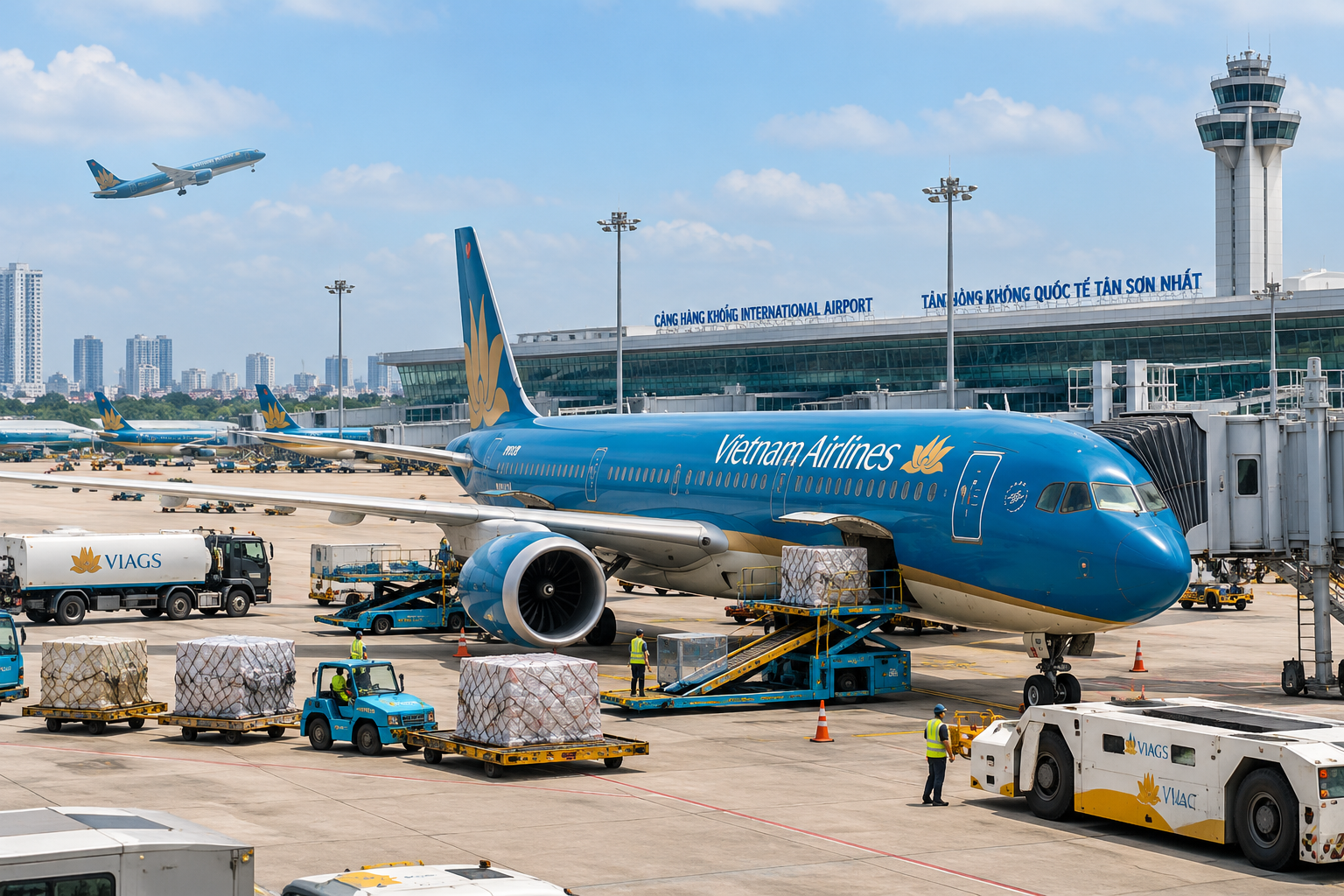
HCM CITY — Aviation authorities are stepping up safety measures around Tân Sơn Nhất International Airport after identifying about 10 areas where unmanned aerial vehicles (UAVs), kites, balloons and laser beams have either been detected or could pose risks to aircraft.
Tân Sơn Nhất is Việt Nam’s largest airport and sits within one of HCM City’s most densely developed areas. Residential neighbourhoods, commercial centres and busy roads lie close to aircraft approach and departure routes, making the control of airborne objects particularly important.
The locations identified include Vạn Phúc City, Thảo Điền, the Thủ Thiêm urban area, Tham Lương, areas near Aeon Mall Tân Phú, Nguyễn Văn Công Street, land near Tân Bình Industrial Park, The Global City, the Hồ Đá area near Vietnam National University HCM City and public spaces near flight paths, including Phạm Văn Đồng Street.
119 incidents recorded since 2024
According to the Southern Airports Authority, 119 incidents involving UAVs, lasers, kites and other airborne objects were recorded around Tân Sơn Nhất from 2024 through early September 2026.
The risks became particularly evident during incidents on August 11 and 13, when a UAV entered an area used for flight operations and a kite equipped with flashing lights was detected. The incidents disrupted airport operations and affected more than 100 flights.
From the beginning of 2026 through September 4, authorities recorded 32 incidents, including 13 involving lasers, eight involving kites, four balloons, three UAVs, three other airborne objects and one involving fireworks.
UAVs pose particular danger to aircraft
Aviation officials have warned that drones represent a serious safety concern because they can rapidly change direction and altitude, making their movements difficult for pilots to anticipate.
Đoàn Văn Minh, deputy head of the Aviation Safety Supervision Division at the Southern Airports Authority, said a collision with a UAV could damage aircraft components.
The danger could be particularly serious if a drone were drawn into an aircraft engine during takeoff or landing, when aircraft are operating at relatively low altitudes near the airport.
Kites and balloons present different challenges because their movements can be difficult to predict or control once airborne.
Laser beams also pose a significant aviation hazard. Powerful lasers directed toward aircraft can temporarily impair or distract pilots, creating additional risks during critical phases of flight.
Dense urban environment adds to challenge
Managing these risks is especially important at Tân Sơn Nhất because the airport is surrounded by heavily populated urban districts.
Activities that might appear harmless at ground level — such as flying a kite, releasing balloons, operating a recreational drone or using powerful outdoor lighting — can create hazards when they occur close to aircraft flight paths.
As drone ownership and recreational use increase, authorities face the additional challenge of ensuring residents understand restrictions governing operations near airports.
Authorities seek stronger prevention measures
HCM City and aviation authorities are calling for stronger public information campaigns to help residents understand the potential consequences of flying drones, kites and other objects near Tân Sơn Nhất.
Officials have also proposed clearer maps showing prohibited and restricted flight zones, together with warning signs in areas close to aircraft approach and departure routes.
Closer coordination is also being sought before authorities approve events involving lasers, powerful lighting systems or other equipment that could interfere with aviation operations.
Improved monitoring and cooperation among aviation authorities, local governments and communities will be important as HCM City continues to grow around one of the country’s busiest aviation hubs.
With millions of passengers travelling through Tân Sơn Nhất each year, preventing drones, kites, balloons, lasers and other uncontrolled objects from entering flight paths remains an important part of maintaining safe and uninterrupted airport operations.