The rhythm of your breathing may influence more than relaxation. New research suggests that deliberately extending the exhalation phase of breathing can alter communication between the heart and brain—and may even affect how people evaluate rewards and make risky decisions.
Researchers from the German Institute of Human Nutrition Potsdam-Rehbruecke (DIfE) and Charité-Universitätsmedizin Berlin investigated whether changing breathing patterns could influence the physiological and neurological processes involved in decision-making.
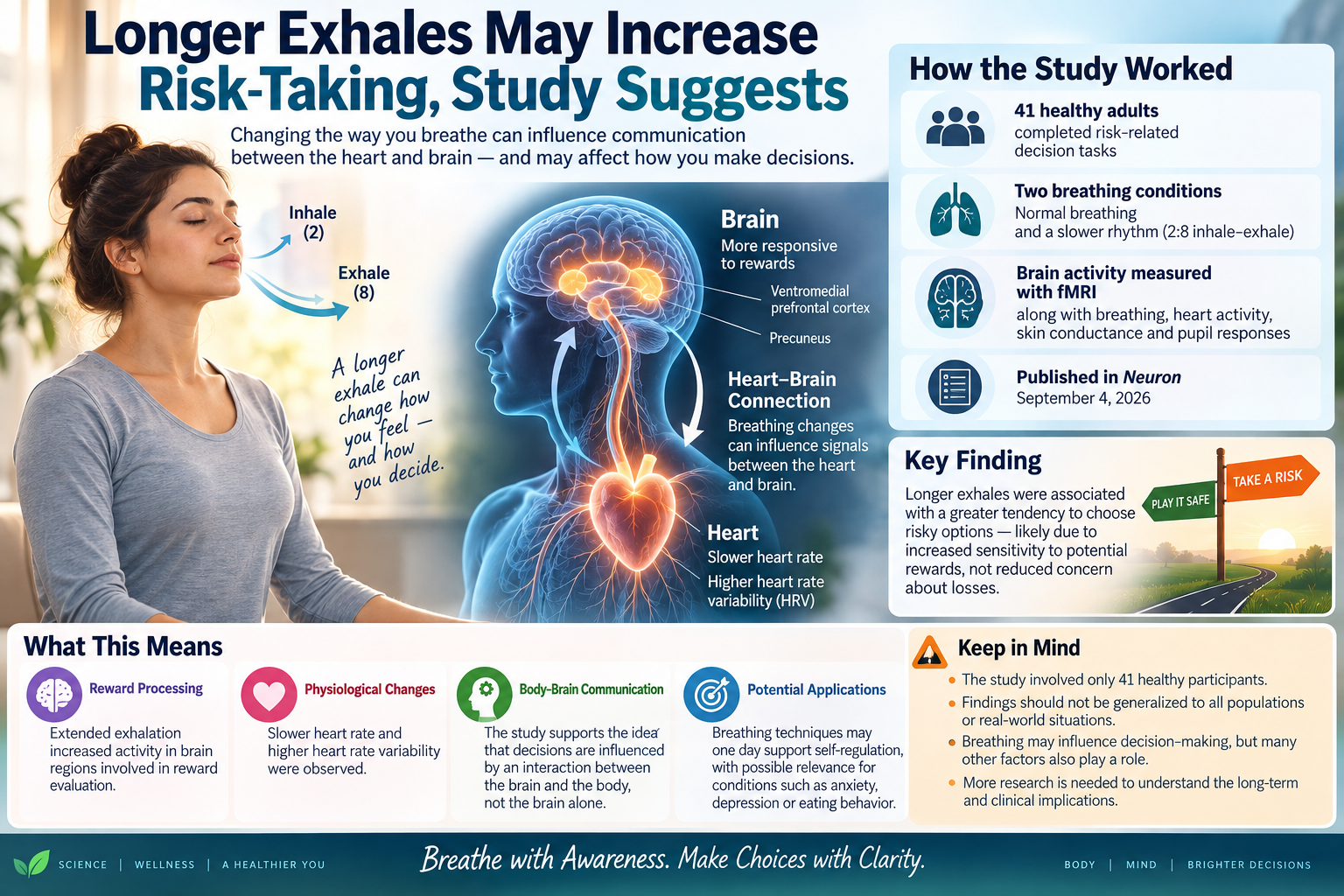
Published in Neuron in September 2026, the study examined 41 healthy adults while they completed risk-based decision tasks. Participants performed the tasks while breathing normally and while following a slower breathing pattern characterized by a substantially longer exhalation than inhalation.
During the experiment, researchers simultaneously monitored brain activity, breathing, heart function, skin conductance and pupil responses, allowing them to examine how changes in respiration affected multiple systems throughout the body.
Breathing Connects the Body and Brain
Decision-making is often treated primarily as a function of the brain. However, growing research into body-brain communication suggests that physiological signals originating elsewhere in the body may also influence cognition.
Breathing is particularly interesting because it operates both automatically and voluntarily. People normally breathe without consciously thinking about it, yet they can intentionally alter breathing speed, depth and rhythm.
The researchers investigated whether manipulating this readily controllable physiological process could influence the neural mechanisms involved in evaluating risk and reward.
Participants therefore completed decision-making tasks under two breathing conditions. In one condition, they breathed normally. In the other, they followed visual instructions encouraging slower breathing with an extended exhalation phase.
The experimental breathing pattern used an inhale-to-exhale ratio of approximately 2:8, creating a pronounced difference between the length of inhalation and exhalation.
Longer Exhales Were Associated With Riskier Choices
The researchers found that extended exhalation altered participants’ cardiovascular activity and was associated with a greater tendency to select risky options.
However, the findings did not suggest that participants simply became less concerned about negative consequences.
Instead, the breathing manipulation appeared to influence how strongly they responded to potential rewards. Responses to possible losses remained relatively similar between the breathing conditions.
This distinction is important because risk-taking can result from different psychological processes. Someone might take a risk because they underestimate potential losses, for example, or because the possible reward becomes particularly attractive.
In this experiment, the second explanation appeared more consistent with the observed results.
Changes Were Detected in Reward-Related Brain Regions
Brain imaging provided another important piece of the picture.
Extended exhalation was associated with changes in activity in the ventromedial prefrontal cortex and precuneus—regions involved in processes that include reward evaluation, decision-making and physiological regulation.
The researchers also observed changes related to heart rate variability (HRV), a measure of variation in the time between heartbeats that is influenced by autonomic nervous system activity.
Together, the results suggest a possible pathway in which deliberately changing breathing alters cardiovascular signals, which interact with brain activity involved in evaluating rewards.
Rather than viewing decision-making as an isolated brain process, the findings support the broader idea that cognition emerges partly through continuous communication between the brain and the rest of the body.
Why Controlled Breathing Is Scientifically Interesting
Controlled breathing has long been incorporated into practices such as meditation and yoga. Slow breathing techniques are also commonly investigated for their potential effects on stress, emotional regulation and autonomic nervous system activity [1–3].
What makes the new research particularly interesting is its focus on decision-making.
Instead of examining breathing only as a relaxation technique, the researchers investigated whether intentionally changing respiratory rhythm could modify the physiological state in which decisions are made.
The results suggest that breathing patterns may influence how the brain processes rewards, although considerably more research will be required before scientists understand how consistent or clinically meaningful the effect may be.
Potential Applications Require More Research
Because breathing exercises require little equipment and can be performed almost anywhere, researchers are interested in whether controlled breathing might eventually become a useful behavioral tool for regulating physiological and psychological states.
One area of interest involves conditions associated with altered autonomic regulation or reward processing, including anxiety and depression.
Another potential research direction involves eating behavior.
Food choices frequently involve weighing immediate rewards against longer-term health considerations. Because reward processing plays an important role in dietary decisions, researchers are interested in determining whether controlled breathing could influence food-related choices.
Future studies may therefore examine people with different health profiles, including populations with overweight or metabolic conditions.
However, the current study involved only 41 healthy participants, meaning its findings should not automatically be generalized to clinical populations or interpreted as evidence that breathing exercises can reliably control real-world decisions.
What the Study Does—and Does Not—Show
The findings do not mean that taking a long breath will automatically make someone reckless or cause them to make poor decisions.
Rather, the experiment suggests something more subtle: deliberately changing the timing of breathing may alter cardiovascular and neural processes associated with reward evaluation, and these physiological changes may influence risk preferences under controlled experimental conditions.
The distinction matters because decision-making is influenced by many factors, including personality, environment, emotions, previous experiences and the specific consequences associated with a choice.
Breathing may represent one physiological factor within that much larger system.
The Bottom Line
The study provides intriguing evidence that the way people breathe may influence the physiological state in which decisions are made.
Extended exhalation was associated with changes in heart rate variability, activity in brain regions involved in reward processing and a greater tendency toward risky choices. The effect appeared to be related more strongly to increased sensitivity to potential rewards than to decreased sensitivity to losses.
The research therefore adds to growing evidence that the heart, lungs and brain operate as an interconnected system rather than as independent components.
Controlled breathing is already widely used to influence relaxation and emotional states. This study raises another possibility: breathing patterns may also subtly influence how the brain evaluates rewards and makes choices.
Further research will be needed to determine how robust the effect is, whether it occurs outside laboratory settings and whether controlled breathing could eventually have useful applications in behavioral or clinical interventions.
References
- Mercola.com. “Controlled Breathing Calms Your Brain.” August 8, 2023.
- Mercola.com. “How Mouth Breathing Can Hurt Your Health and Well-Being.” January 31, 2019.
- Mercola.com. “A Tiny Spot in Mouse Brains May Explain How Breathing Calms the Mind.” April 13, 2017.
- Chaitow, Leon; Gilbert, Chris; Bradley, Dinah. Recognizing and Treating Breathing Disorders: A Multidisciplinary Approach.
- Huang, Wenhao, et al. “Slow Breathing Impacts Inter-Organ Dynamics Modulating Brain Function and Risk Behavior.” Neuron, 2026.