
Forty Years of Changing Childhood: Empty Playgrounds, Digital Distractions, Academic Decline, and the Search for Human Connection
Melody Wallack, MD | Health & Wellbeing | October 14, 2026
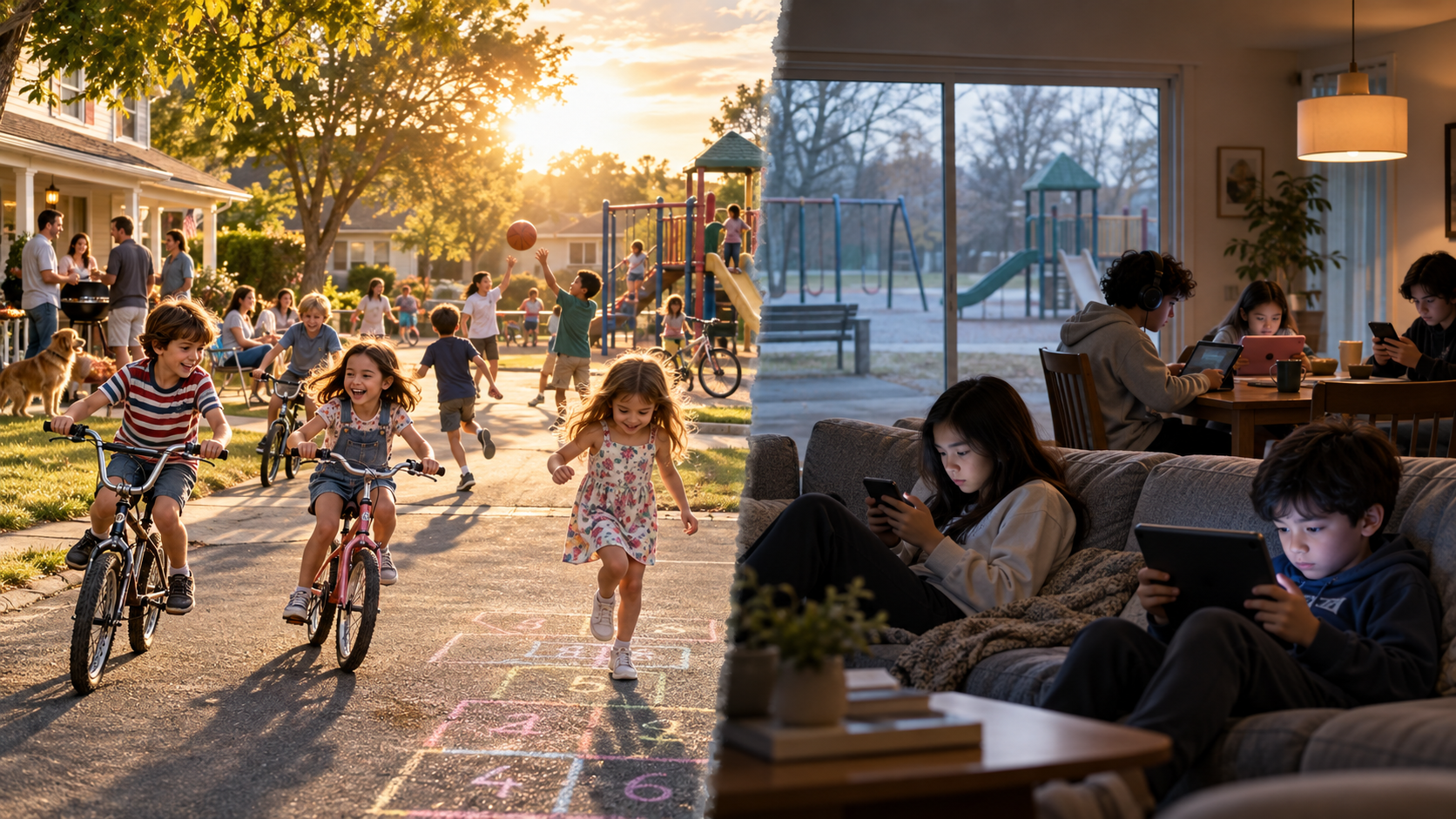
A generation ago, the sound of children laughing, shouting, riding bicycles, and playing outside was a familiar part of neighborhood life.

Today, many parents and grandparents look around their neighborhoods and wonder why the playgrounds seem so quiet.

At the same time, researchers have documented troubling changes in adolescent mental health, student achievement, sleep, and the way young people spend their free time.
Are these developments connected? Has modern technology made childhood easier while inadvertently reducing opportunities for something children need even more—genuine human interaction?
The answers are complicated. But understanding them may help families restore something valuable that modern life sometimes pushes aside.
Human Beings Were Born to Connect
Long before smartphones, automobiles, schools, or modern cities existed, human beings survived by working together.
Our ancestors relied on communities to find food, provide shelter, protect one another, raise children, and pass knowledge from one generation to the next.

Children learned by observing adults, playing with other children, imitating everyday activities, and gradually taking on responsibilities.
Across thousands of years, human societies developed different cultures, family structures, and ways of life. Yet one fundamental need remained remarkably consistent.
Human beings are profoundly social creatures.
We need connection not merely for entertainment but for development, security, learning, and emotional well-being.

Young children depend on responsive caregivers to help them understand the world. As they grow older, friendships and community relationships become increasingly important.
Through interactions with other people, children learn language, cooperation, empathy, conflict resolution, and how to respond when things do not go their way.
Our technology has changed dramatically in the past four decades.

Our fundamental need for human connection has not.
Remember When Children Played Outside?
Think back to a typical afternoon in the 1980s or 1990s.
School was over.

Children rushed home, dropped their backpacks, changed their clothes, and went outside looking for their friends.
Someone brought a bicycle. Someone else brought a basketball. A group started playing hide-and-seek, tag, jump rope, or whatever game came to mind.
Children knocked on neighbors’ doors to ask whether their friends could come out.
They did not always need an organized activity or an adult directing every minute.
They invented their own games.

Sometimes they argued. Sometimes someone cried. Sometimes they had to negotiate new rules or apologize to a friend.

But through those ordinary experiences, they were learning how to live with other people.
Weekends offered additional opportunities.
Parks and playgrounds became meeting places for families.

Children ran, climbed, swung, and played together. Parents talked while watching from benches or picnic tables. Grandparents enjoyed seeing the younger generation explore the world.
The laughter and occasional shouting of children were ordinary sounds of community life.
These memories can be beautiful, but they do not represent every child’s experience. Earlier generations also faced bullying, unsafe neighborhoods, discrimination, family hardship, and social isolation.
The past was not perfect.
Still, many adults remember an important feature of childhood that seems less visible in some communities today: spontaneous outdoor play with neighborhood friends.
The Empty Playground: A Personal Observation
In one Texas neighborhood, a VietEcho contributor who regularly walks through a local park has noticed something striking.
The playground is often empty.

There may be no children running across the grass, no bicycles gathered near the entrance, and no families occupying the benches.
Even some indoor children’s play areas in shopping malls appear surprisingly quiet.
During annual Christmas family visits to California, the same contributor has noticed another change.
In earlier years, family gatherings were filled with children playing, laughing, running from room to room, and inventing games together.
More recently, children ranging from toddlers to teenagers have often been occupied with individual electronic devices.
The family members are physically together, but many of the children are focused on separate screens.
These observations are personal experiences, not evidence that every American playground is empty or that all children now prefer devices to companionship.
Other neighborhoods continue to have lively parks, bustling sports fields, and active community events.
Nevertheless, the contrast raises a question worth investigating:
Where have the children gone?
Are they indoors?
Are they studying or attending organized activities?
Are their parents working?
Are families reluctant to let children play outside because of traffic, weather, safety concerns, or a lack of other children nearby?

Or have electronic devices become such a convenient and compelling source of entertainment that outdoor play is no longer the automatic choice?
The answer likely involves several of these factors.
And it may reveal as much about changes in family life as it does about children themselves.
A Society With More Technology—and Significant Emotional Distress
Today’s children have advantages previous generations could scarcely imagine.
They can access enormous libraries of information from home, communicate with relatives across oceans, use powerful educational software, and receive medical care informed by decades of scientific progress.
Yet improvements in technology and material comfort have not eliminated emotional suffering.
The CDC’s Youth Risk Behavior Survey offers one important measure of adolescent well-being in the United States.
Among surveyed high school students, persistent feelings of sadness or hopelessness increased from approximately 30% in 2015 to 42% in 2021.
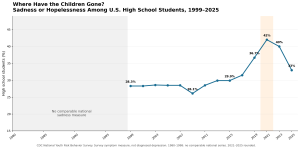
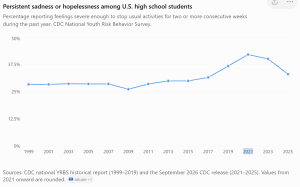
The percentage declined to 40% in 2023 and then to 33% in 2025.
This is both troubling and encouraging.
The 2021 figure reflected particularly widespread distress during the COVID-19 pandemic.
The improvement since then shows that conditions are not worsening indefinitely.
However, the 2025 percentage remained above its 2015 level.
Researchers have also documented concerns about loneliness, sleep deprivation, anxiety, and suicidal behavior among young people.
Importantly, sadness or hopelessness reported in a survey is not the same as a physician’s diagnosis of clinical depression.
These figures describe reported emotional experiences, not the percentage of teenagers who have major depressive disorder.
We also cannot draw a simple line from the 1990s to today without accounting for changes in mental health awareness, measurement, and willingness to disclose symptoms.
What the available data clearly tell us is that emotional distress has affected a substantial proportion of American adolescents—and that the COVID-19 years were especially difficult.
COVID-19 and the Emotional Cost of Disconnection
The COVID-19 pandemic disrupted ordinary childhood life.

Schools closed or shifted to remote learning. Sports programs and community events were canceled. Birthday parties, family visits, and social gatherings were postponed.
Some children experienced illness or the death of loved ones.
Others faced financial hardship, household conflict, food insecurity, or prolonged isolation.
For many students, classroom learning moved from an environment filled with peers and teachers to a computer screen at home.
Technology helped education continue, but it could not fully replace every element of school life.
A school is more than a building for academic instruction.
It is also a place where children practice social interaction, develop friendships, experience teamwork, and receive encouragement from adults outside their families.
When these opportunities were interrupted, many children lost important parts of their daily routine.
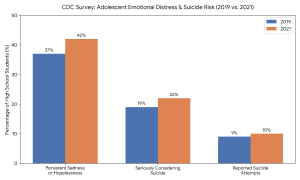
The CDC’s national survey captures the severity of emotional distress during that period.
In 2019, 37% of surveyed high school students reported persistent sadness or hopelessness.
By 2021, that figure had reached 42%.
During the same period, the percentage seriously considering suicide rose from 19% to 22%.
Reported suicide attempts increased from 9% to 10%.
Those changes should be understood within the context of broader pandemic stress—not treated as proof that school closures alone caused them.
Adolescent emotional distress had already been increasing before COVID-19.
The pandemic intensified an existing public health challenge rather than creating every underlying problem.
Encouragingly, the newest 2025 survey shows improvement across several mental health and suicide-risk measures.
That is evidence that recovery and progress are possible.
Suicide Risk: A Serious Problem That Requires Accurate Reporting
Suicide is among the most serious public health concerns affecting young people.
It is also a subject that requires careful language.
Three measurements are often confused.
Suicidal thoughts refer to thinking seriously about ending one’s life.
A suicide attempt is a self-reported or documented act of attempting suicide.
A suicide death is a death classified as resulting from suicide.
These are related but distinct measures. They should not be combined into a single statistic.
According to the CDC’s 2025 Youth Risk Behavior Survey, 14% of high school students reported seriously considering suicide during the previous year, compared with 22% in 2021.
Six percent reported a suicide attempt in 2025, compared with 10% in 2021.
These declines represent meaningful progress.
However, even the lower percentages describe large numbers of young people experiencing serious distress.
Suicide mortality data tell a different story and must be examined separately.
The CDC reported 48,824 suicide deaths across all ages in the United States in 2024. That total should not be interpreted as a figure for children or teenagers.
Recent mortality statistics also show that suicide rates differ substantially according to age and sex, and that not every group experienced the same trend.
Public discussion should therefore avoid suggesting that suicide deaths among children have increased every year or that every youth demographic follows an identical pattern.
More importantly, awareness should lead to support rather than fear.
Children and teenagers who express hopelessness, talk about wanting to die, or show other serious warning signs deserve immediate attention, compassion, and appropriate professional evaluation.
Early intervention can save lives.
Are Children Learning Less Despite Having More Information?
Another troubling development concerns academic performance.

Today’s students can access information within seconds.
They have online textbooks, digital libraries, educational videos, interactive applications, and AI-assisted learning tools.
Yet easy access to information does not necessarily mean that students are developing stronger reading comprehension, mathematical reasoning, or independent problem-solving skills.
The National Assessment of Educational Progress, widely known as the Nation’s Report Card, documents significant declines in several academic measures.
Among U.S. 12th-grade students, the average reading score in 2024 was three points lower than in 2019 and ten points lower than in 1992.
The average mathematics score in 2024 was also three points lower than in 2019.
In mathematics, 45% of 12th-grade students scored below the NAEP Basic achievement level in 2024, compared with 40% in 2019.

These are measurable educational concerns.
But the findings require an important distinction.
Lower academic test scores do not prove that children have become less intelligent or that their IQs have declined by the same amount.
Academic achievement depends on numerous factors, including instruction, attendance, learning opportunities, reading habits, family resources, school disruptions, and motivation.
Pandemic-related educational interruptions almost certainly affected some students, although academic trends began changing before 2020.
There are also ongoing debates about grading practices, standards-based education, the use of technology in classrooms, and whether students receive sufficiently clear feedback about their progress.
Families and educators may reasonably disagree about the best grading systems.
Nevertheless, children benefit from meaningful expectations, honest assessment, opportunities to correct mistakes, and encouragement to persist through difficult tasks.
Technology should expand the ability to learn—not eliminate the need to practice thinking.
The Difference Between Information and Understanding
Modern technology provides answers quickly.
A student can search for a historical date, calculate a mathematical result, summarize a novel, or generate an essay in seconds.

That convenience is extraordinary.
But learning involves more than obtaining an answer.
Reading a difficult passage builds comprehension and vocabulary.
Solving a mathematics problem independently develops reasoning and persistence.
Writing an essay requires organizing ideas, evaluating evidence, and communicating clearly.
Even struggling with a difficult assignment can teach a student how to tolerate frustration and work through uncertainty.
AI and digital tools can support these processes when used appropriately.
They may be especially helpful for tutoring, accessibility, language learning, and personalized explanations.
The challenge is ensuring that technology supports learning rather than consistently replacing the mental effort through which learning occurs.
A child who always receives instant answers may need additional opportunities to practice discovering answers independently.
Why Two-Income Family Life Matters
One of the most important changes affecting childhood may have less to do with children and more to do with the economic circumstances of their families.
Many households depend on the earnings of two adults.
In 2025, both parents were employed in approximately 66% of U.S. married-couple families with children, according to the Bureau of Labor Statistics.
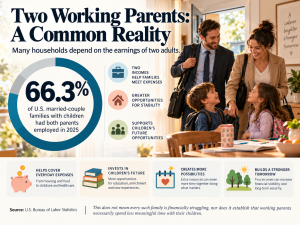
This statistic does not mean every such family is financially struggling, nor does it establish that working parents necessarily spend less meaningful time with their children.
But it does demonstrate how common dual-earner parenting has become.
Housing, childcare, transportation, insurance, food, and other necessities can create substantial financial pressure.
Many parents leave home early, commute to work, spend long hours on the job, and return to another set of responsibilities.
Dinner must be prepared. Dishes need washing. Laundry is waiting. Homework requires attention. Bills must be paid.
Some parents also work evenings, weekends, or rotating shifts.
Others raise children without a second adult in the household.
By the time the essential tasks are finished, physical and emotional exhaustion may leave little energy for additional activities.
A trip to the park can feel like another obligation rather than a chance to relax.
This does not mean parents love their children less.
It means families often face competing demands that previous generations experienced differently.
Any discussion of modern childhood must acknowledge these pressures without blaming mothers or fathers who are working hard to provide for their families.
How Digital Devices Became the Convenient Babysitter
Consider a familiar evening in a busy household.
A parent returns home exhausted after work.
A small child wants attention.

The child is energetic, noisy, curious, and eager to move.
Meanwhile, dinner needs to be prepared and several tasks remain unfinished.
The parent hands the child a tablet.
The room becomes quiet.
The child is entertained, and the parent can complete necessary work.
In the short term, this may be a practical solution.
There is no reason to shame parents for occasionally relying on age-appropriate digital entertainment while cooking, resting, or managing responsibilities.
But a potential concern arises when devices repeatedly become the default answer to boredom, frustration, restlessness, and requests for attention.
Children may begin to rely on a continuous stream of digital stimulation.
Activities that move at a slower pace—reading, drawing, building toys, conversations, imaginative play, or outdoor exploration—may receive less attention.
The 2025 Common Sense Census reported that children eight years old and younger spent an average of about two hours and 27 minutes per day using screen media.
The study also reported that approximately 40% of two-year-olds had their own tablet.

Screen use varied considerably among children, and not every digital activity was the same.
Educational videos, video calls with grandparents, creative projects, and passive entertainment provide different experiences.
The central concern is what may be displaced when screen use becomes extensive.
Is the child sleeping enough?
Is there time for active play?
Does the child interact regularly with other children?
Are caregivers available for conversation and comfort?
Do children have opportunities to manage boredom and discover ways to entertain themselves?
These questions are more useful than automatically treating every minute of screen time as harmful.
Social Media and the Pressure of Constant Comparison
For teenagers, digital life introduces additional challenges.
Friendships now continue through messaging applications, video platforms, group chats, and social networks.

These technologies can help young people stay connected and find communities with shared interests.
But they may also expose users to cyberbullying, exclusion, unrealistic appearance standards, social comparison, and disturbing material.
Thirty years ago, an embarrassing event at school might gradually fade from classmates’ attention.
Today, photographs and comments can circulate quickly and remain accessible.
A teenager may feel pressure to monitor reactions, respond immediately, or compare their life with carefully selected images from other people.
The U.S. Surgeon General’s 2023 advisory warned about the risks associated with social media use among young people.
It cited research linking more than three hours of daily social media use with roughly twice the risk of certain mental health problems, including symptoms of depression and anxiety.

However, this association does not demonstrate that social media causes depression in every user.
Young people who are already experiencing emotional difficulties may also spend more time online.
The effects depend partly on what children do online, whom they interact with, and how those experiences affect their daily lives.
Families can help by maintaining open conversations about online experiences and teaching children how to recognize harmful interactions.
The goal should be thoughtful use, not fear of technology itself.
The Vanishing Opportunity to Be Bored
Older generations often remember complaining that there was nothing to do.
Without unlimited entertainment available on demand, children sometimes had to invent ways to occupy themselves.
They made up games, explored outdoors, built things, drew pictures, read books, or sought out friends.
Boredom could become an invitation to creativity.
Today’s children have access to nearly endless entertainment.
A new video, game, or notification is always available.
That does not automatically prevent creativity, and many children use digital tools in imaginative ways.
But when every quiet moment is immediately filled, children may have fewer opportunities to practice generating their own ideas without external stimulation.
Independent play helps children develop initiative and problem-solving skills.
It also teaches them that not every uncomfortable feeling requires an immediate distraction.
An age-appropriate opportunity to experience boredom can become an opportunity to discover an interest.
What Children Learn on the Playground
The American Academy of Pediatrics emphasizes that play contributes to social-emotional development, cognition, language, and self-regulation.
When children play together, they learn how to negotiate, cooperate, solve problems, and understand another person’s perspective.
Imagine several children inventing a ball game.

They must decide on rules.
They negotiate turns.
Someone makes a mistake.
Another child becomes frustrated.
The group must find a way to continue.
These ordinary interactions provide opportunities to practice skills that will matter in school, employment, friendships, and family life.
Outdoor play also encourages movement and may create opportunities for children to explore their surroundings.
Children do not need to participate in expensive programs to benefit.
A walk, a bicycle ride, a game of catch, or a visit to a nearby playground can provide valuable experiences.
Importantly, children should have opportunities to play not only with adults but also with peers.
Friendship involves learning to interact with people who do not always think or behave exactly as we do.
These experiences cannot be fully replicated through a device.
Why Some Parks Are Empty
The image of an empty playground is emotionally powerful.
But it would be inaccurate to assume screens are the only explanation.
Children may be unable to walk safely to parks because of heavy traffic or a lack of sidewalks.
In some regions, extreme heat makes outdoor play uncomfortable or dangerous during large portions of the day.
Parents may have concerns about neighborhood safety or supervision.
Families may live far from recreational facilities or lack transportation.
Children may attend organized activities instead of gathering informally.
In some neighborhoods, relatively few families have children of similar ages.
And a parent may not want a young child playing outdoors alone when no other families are present.
Creating lively public spaces therefore requires both family participation and community support.
Safe streets, shaded play areas, accessible parks, reliable maintenance, and organized opportunities for families to meet can all help.
An empty playground is not necessarily evidence of parental neglect.
It may be evidence that modern communities need to make childhood play easier.
The Sleep Problem
Sleep is another important part of the story.
Adolescents generally need eight to ten hours of sleep each night.
Yet CDC data show that only 24% of U.S. high school students obtained at least eight hours on an average school night in 2025.
Insufficient sleep can interfere with attention, learning, emotional regulation, and stress management.
Sleep difficulties may also aggravate mental health symptoms.
Many factors contribute to inadequate rest.
Teenagers’ biological sleep patterns shift during adolescence. Early school start times can make sufficient sleep difficult.
Homework, extracurricular activities, family responsibilities, and part-time employment also compete for time.
Late-night gaming, videos, and notifications may further delay bedtime.
Families can help by protecting sleep routines, encouraging device-free time before bed, and reducing nighttime interruptions.
Healthy sleep is not a reward for finishing every other task.
It is a fundamental developmental need.
Vietnamese and Immigrant Families: Different Generations, Different Childhoods
For immigrant families, these changes may be particularly striking.

Parents or grandparents who grew up in Vietnam or other countries may remember childhoods centered on extended family, neighborhood friendships, and frequent interaction with relatives.

Some experienced war, displacement, poverty, or difficult migration journeys.
Their determination to build stable lives often required extraordinary sacrifices.
Their children and grandchildren may grow up surrounded by technology, greater material comfort, and very different cultural expectations.
The generations may struggle to understand each other’s experiences.
A parent may believe that children who have food, housing, education, and modern conveniences should naturally be happy.
A teenager may feel lonely or overwhelmed despite appreciating those advantages.
Both perspectives can exist within a loving family.
The challenge is finding a shared language for discussing emotional needs.
A child who feels anxious or depressed does not necessarily lack gratitude.
And parents who are exhausted or uncertain about technology are not necessarily uncaring.
Families benefit when members listen with curiosity rather than immediately judging one another.
Intergenerational gatherings, shared meals, cultural traditions, family stories, and opportunities for children to interact with relatives can all strengthen a sense of belonging.
The goal is not to reject modern life.
It is to preserve meaningful family connections while adapting to it.
Mental Health Problems Need More Than Lifestyle Advice
Outdoor play, family interaction, sleep, and healthy routines can support well-being.
But they are not guaranteed cures for depression or other mental health conditions.
A child may develop depression even in a stable, loving, active household.
Mental health conditions involve complex interactions among biology, environment, life experiences, and individual circumstances.

Warning signs may include persistent sadness or irritability, withdrawal from friends, loss of interest in favorite activities, significant sleep or appetite changes, declining school performance, or feelings of hopelessness.
Some children express distress through anger or physical complaints.
Parents should seek appropriate professional evaluation when changes persist, worsen, or interfere with daily life.
Any statement about self-harm or suicide deserves serious attention.
Effective treatment may include evidence-based psychotherapy, medication when appropriate, family support, and coordinated healthcare.
Supportive family activities can complement professional treatment but should not replace it when care is needed.
Simple Ways to Bring Families Back Together
The challenges facing modern families are substantial.
Most parents cannot eliminate financial pressures, redesign school schedules, or change the way digital platforms operate.
But families and communities can begin with small steps.
The goal is not to create another demanding checklist for exhausted parents.
It is to make connection easier, more frequent, and more enjoyable.
1. Make Time for the Playground

Even a short visit to a neighborhood park can give children a chance to run, climb, explore, and interact with others.
Parents do not need to arrange an elaborate outing.
A 20- or 30-minute visit after school or dinner may be enough to establish a routine.
Families should choose safe, age-appropriate activities and consider local weather conditions.
2. Bring Back Weekend Park Visits
Families can set aside time on weekends to visit a park, walk on a trail, enjoy a picnic, or ride bicycles.

The outing does not need to cost money.
Children may remember the time spent together more than the destination.
3. Share the Responsibilities Among Family Members
When parents work demanding schedules, grandparents, aunts, uncles, older siblings, and trusted relatives may be able to help.
For example, one adult might take the children to a park on Saturday morning while another supervises an activity on Sunday.

Such arrangements should always consider children’s ages, safety, and each caregiver’s abilities.
No parent should feel that every activity must be handled alone.
4. Organize a Monthly Family Gathering
A family gathering once a month can create opportunities for children to connect with cousins, grandparents, and other relatives.
Families might rotate hosting responsibilities.

Activities can include shared meals, outdoor games, storytelling, music, or simple celebrations.
Adults can encourage children to put their devices aside for part of the gathering without turning the event into a punishment.
The goal is to help children rediscover the enjoyment of being together.
5. Spend 30 Minutes Playing With Your Child
A father might ride bicycles with his children, throw a ball in the backyard, or help them practice a sport.

A mother might take a walk, play a game, garden, or spend time drawing with them.
Of course, either parent or caregiver can enjoy any of these activities.
The important part is undivided attention.
Thirty minutes of genuine interaction may be more meaningful than several hours spent physically together while everyone looks at separate screens.
6. Walk the Dog Together
A family dog provides a natural reason to go outside.

Parents and children can take turns walking the dog together, subject to the child’s age and ability to handle the animal safely.
These ordinary walks can create opportunities for conversation without the pressure of sitting down for a formal discussion.
Children may talk more freely while walking than when directly questioned at the dinner table.
7. Create Reasonable Device Boundaries
Families can establish routines such as completing homework and essential responsibilities before recreational screen time.
They can also protect device-free meals, family activities, and nighttime routines.

Rules should be appropriate for the child’s age and individual needs.
Parents should distinguish necessary educational device use from recreational entertainment.
It is also helpful for adults to follow similar expectations during shared family time.
A healthy relationship with technology is more sustainable when it is taught through example rather than constant conflict.
8. Read to Young Children Before Bed
Reading aloud supports language development, shared attention, and emotional connection.
Parents can allow young children to choose books, ask questions about stories, and discuss characters.

Older children may prefer independent reading followed by a conversation about what they learned.
The goal is not simply to improve academic performance.
It is to associate reading with comfort, curiosity, and enjoyable time together.
9. Restore a Peaceful Bedtime Ritual
Families can develop routines that help children settle at night.
These might include reading, talking about the day, expressing gratitude, quiet reflection, or prayer according to the family’s beliefs.

Parents who practice a religious or spiritual tradition may find that praying with their children creates an opportunity to share values and experience a peaceful moment together.
Families without religious traditions can establish equally meaningful routines through conversation, gratitude, or quiet reflection.
The important element is a predictable, reassuring connection before sleep.
10. Join Community Programs and Sports
Local parks departments, recreation centers, schools, libraries, and community organizations often provide activities for children.
These may include sports, art classes, reading clubs, music programs, nature activities, and seasonal events.

Affordable programs can give children opportunities to make friends while helping parents connect with other families.
When possible, communities should ensure that cost and transportation do not prevent participation.
11. Let Children Experience Safe Independence
Children need opportunities to make choices, handle small disagreements, and practice solving problems.
Age-appropriate independence might include planning a game, helping prepare dinner, choosing a book, or organizing an activity with friends.

Adults should provide safe boundaries without supervising every minor decision.
Learning to tolerate frustration and recover from mistakes is an important part of growing up.
12. Ask One Question Every Day
Parents can establish a simple habit of asking:
What was the best part of your day, and what was the hardest?

Then listen.
A child may not always want to talk, and that is okay.
What matters is knowing that someone remains available.
Sometimes the most valuable contribution a parent can make is not providing an answer.
It is creating a safe place where a child can speak.
A Challenge for Neighborhoods: Bring the Playgrounds Back to Life

Families may find it easier to change their routines when other families participate.
Imagine neighbors agreeing to meet at a park once each week.
One family brings a soccer ball.
Another brings snacks.
Children begin playing while adults talk.
Soon, the children start asking when they can return.
This kind of gathering requires relatively little money or organization.
Schools, faith communities, libraries, neighborhood associations, and recreation departments can help bring families together.
Safe playgrounds need more than swings and slides.
They need people.
And rebuilding that sense of community may benefit adults as well as children.
Parents can develop friendships and informal support networks.
Older residents may feel more connected to their neighborhoods.
Children can meet peers beyond classrooms and organized activities.
The benefits extend beyond recreation.
They help restore a sense that people belong to one another.
The Future Does Not Have to Be a Lonely One
It would be easy to conclude that modern technology has damaged childhood beyond repair.
The evidence does not support such a simple verdict.
Technology provides enormous benefits.
It can improve access to education, connect distant relatives, support children with disabilities, and introduce young people to opportunities that once seemed impossible.

Recent improvements in adolescent mental health statistics also demonstrate that negative trends are not inevitable.
The goal is not to return to a world without smartphones, computers, or artificial intelligence.
Nor is it to demand that parents recreate every tradition of the 1980s or 1990s.
The goal is balance.
Children need technology, education, and opportunities to prepare for an increasingly complex world.
But they also need friendship, movement, creative play, sleep, affection, emotional security, and meaningful time with people who care about them.
Those needs are not outdated.
They are fundamental features of being human.
Where Have the Children Gone?
Perhaps this question should be followed by another.

What can we do to bring them together again?
We can start small.
Take a child to the park.
Invite the cousins over.
Read one more bedtime story.
Put the phones away during dinner.
Throw a ball in the backyard.
Walk the dog together.
Listen when a child wants to talk.
And when possible, make room for the familiar sound of children laughing, running, and playing together.
Because the sound of a lively playground is more than childhood entertainment.
It is one expression of a community in which people continue to connect, care, learn, and grow.
Forty years of technological progress have transformed the world. Perhaps our next great achievement should be making sure that, amid all this progress, no child feels forgotten.

Mental Health Resources
If a child or teenager experiences persistent sadness, withdrawal, severe anxiety, or major changes in daily functioning, consider consulting a pediatrician or qualified mental health professional.
Take statements about self-harm or suicide seriously.
In the United States, call or text 988 to reach the Suicide & Crisis Lifeline. If someone is in immediate danger, call 911 or local emergency services.
This article is for educational purposes and does not replace individualized medical or mental health care.
Research Sources
- CDC, Mental Health and Suicide Risks: Youth Risk Behavior Survey, 2015–2025, September 18, 2026.
- CDC, Changes in Suicide Rates in the United States From 2023 to 2024, September 2026.
- National Center for Education Statistics, 2024 NAEP Reading Assessment: Grade 12 Results for the Nation, September 2025.
- National Center for Education Statistics, 2024 NAEP Mathematics Assessment: Grade 12 Results for the Nation, September 2025.
- Bureau of Labor Statistics, Employment Characteristics of Families — 2025, April 2026.
- Common Sense Media, The 2025 Common Sense Census: Media Use by Kids Zero to Eight, February 2025.
- American Academy of Pediatrics, The Power of Play: A Pediatric Role in Enhancing Development in Young Children, 2018, reaffirmed 2025.
- U.S. Surgeon General, Social Media and Youth Mental Health, 2023.
- CDC, Sleep: Youth Health in Focus, September 2026.