
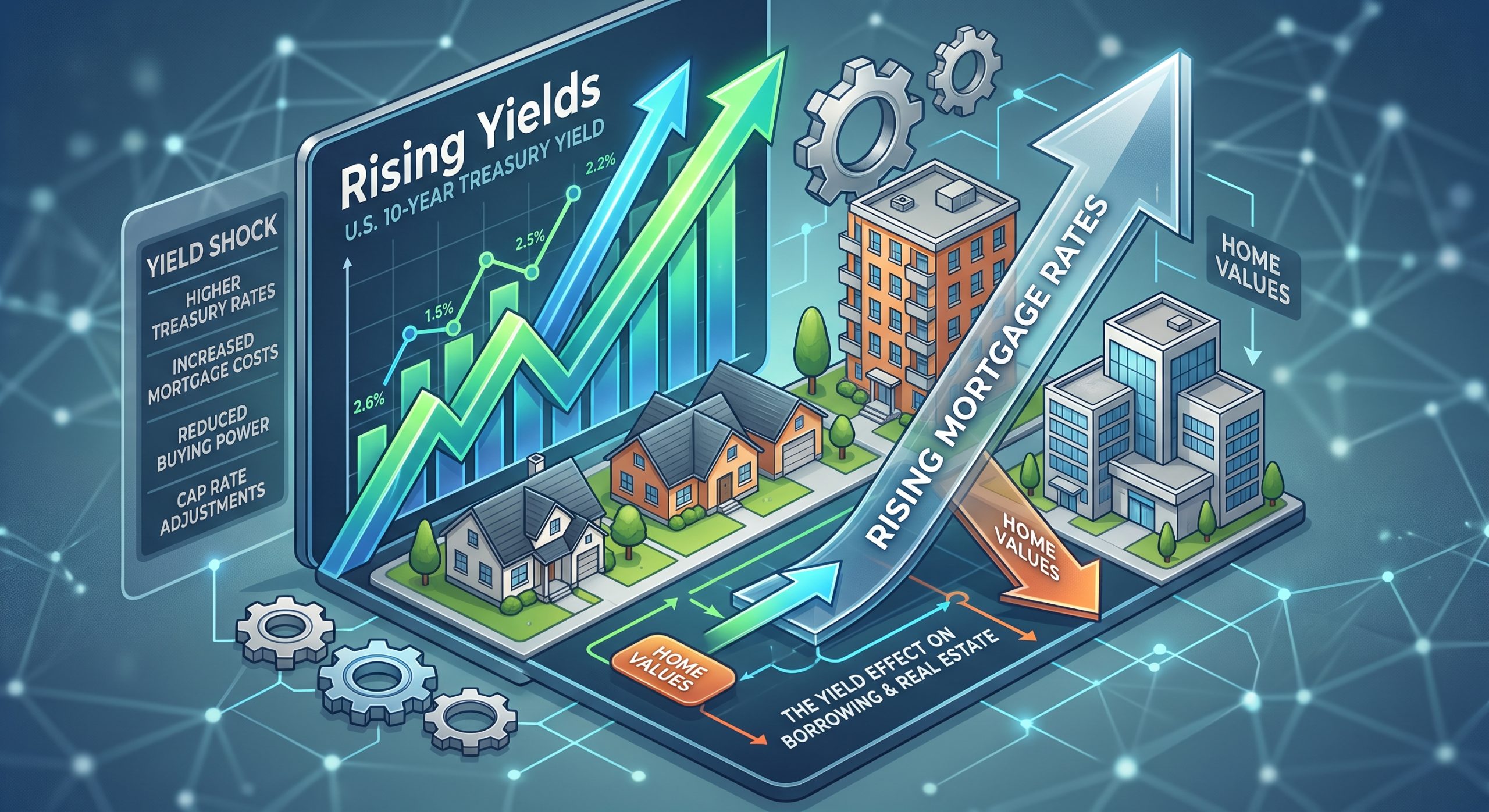
Yield Shock: Why Rising Treasury Rates Are Rewriting the Rules for Real Estate and Borrowing
The bond market is sending a clear signal across global finance: bond yields are climbing to multi-decade highs, with the benchmark 10-year U.S. Treasury yield breaking past 5.3%.
For years, cheap credit fueled everything from residential home buying to commercial real estate ventures and institutional corporate debt. Today’s rate environment represents a structural regime shift. Understanding how rising Treasury yields ripple through the real economy—and specifically real estate—is crucial for navigating the months ahead.
The Mechanics: Why the 10-Year Treasury Drives Everything
While headlines often focus on the Federal Reserve’s decisions regarding short-term policy rates, the 10-year U.S. Treasury yield is the true anchor of global borrowing costs.
Treasuries set the baseline risk-free rate of return. When Treasury yields rise, all other debt instruments—from corporate bonds to fixed-rate residential mortgages—must adjust upward to offer a competitive spread to compensate investors for risk.
┌──────────────────────────────┐
│  10-Year U.S. Treasury Yield │ ──► Base Risk-Free Rate (~5.3%)
└──────────────┬───────────────┘
               │ + Risk / Duration Spread (~1.8 - 2.0%)
               ▼
┌──────────────────────────────┐
│  30-Year Fixed Mortgage Rate │ ──► Fixed Rate Borrowing Costs (~7.1% - 7.3%)
└──────────────────────────────┘
Historically, the spread between the 10-year Treasury yield and a 30-year fixed mortgage averages roughly 1.7 to 2.0 percentage points. With 10-year Treasuries holding above 5.3%, 30-year fixed mortgage rates naturally hover above 7%.
1. Residential Real Estate: The “Lock-In Effect” and Purchasing Power
The residential housing market is currently experiencing two opposing forces: persistent price resilience and constrained transaction volume.
-
Erosion of Buyer Purchasing Power: Every percentage point increase in mortgage rates diminishes a homebuyer’s borrowing power by roughly 10%. On a standard $400,000 mortgage loan, the difference between a 5.75% rate and a 7.25% rate translates to over $380 in additional monthly principal and interest payments—excluding property taxes and insurance.
-
The “Lock-In” Inventory Bottleneck: Millions of existing homeowners hold mortgage rates locked below 4% from previous years. Selling a home to buy another means trading a low monthly payment for a significantly higher borrowing cost. This “golden handcuff” phenomenon severely limits secondary housing inventory, keeping home prices sticky despite lower buyer volume.
Advertisement
2. Commercial Real Estate & Debt Refinancing: The Valuation Gap
In commercial real estate (CRE), rising yields directly alter cap rates (capitalization rates)—the rate of return an investor expects on a commercial property.

As the risk-free baseline yield climbs toward 5.3%, commercial buyers require higher cap rates to justify the risk over standard government debt.
-
Valuation Pressure: To achieve higher cap rates without a matching rise in rental revenue, property valuations must adjust downward.
-
Refinancing Walls: Commercial properties purchased or refinanced during low-rate cycles using short-term floating-rate debt or 3- to 5-year terms face significant refinancing hurdles. Replacing debt originally issued at 3.5% or 4% with debt priced at 7% to 8% compresses cash flow and requires equity top-ups.
Advertisement
Strategic Takeaways for Investors and Operators
-
Prioritize Free Cash Flow Over Leverage: In high-yield regimes, aggressive financial leverage works against deal economics. Deals built on conservative debt-service coverage ratios (DSCR) and durable net operating income withstand rate spikes far better than speculative equity plays.
-
Focus on Short-Duration Leasing Assets: Real estate segments with flexible leasing terms—such as multi-tenant industrial spaces, self-storage, or residential units—allow operators to reset rents faster to match inflation and higher financing costs.
-
Monitor the Yield Curve: The relationship between short-term Treasury bills and long-term notes provides insight into market expectations regarding inflation, liquidity, and Federal Reserve policy.
Rising yields represent a return to historical capital costs rather than an anomaly. Investors and operators who structure balance sheets around this economic reality will be best positioned for sustainable, long-term growth.