Hip stiffness can make everyday movements—from getting out of a chair to climbing stairs—feel more difficult than they should. Long periods of sitting, limited physical activity and inadequate strength around the hips may all contribute to reduced mobility over time.
A well-rounded hip routine should do more than simply stretch tight muscles. Combining flexibility work with exercises that strengthen the glutes and surrounding hip muscles can help support movement, stability and functional range of motion.
The following six exercises combine stretching, strengthening and functional movement. They can generally be performed at home with minimal equipment, although people with existing injuries or persistent hip pain should consult a healthcare professional or physical therapist before beginning a new exercise program.
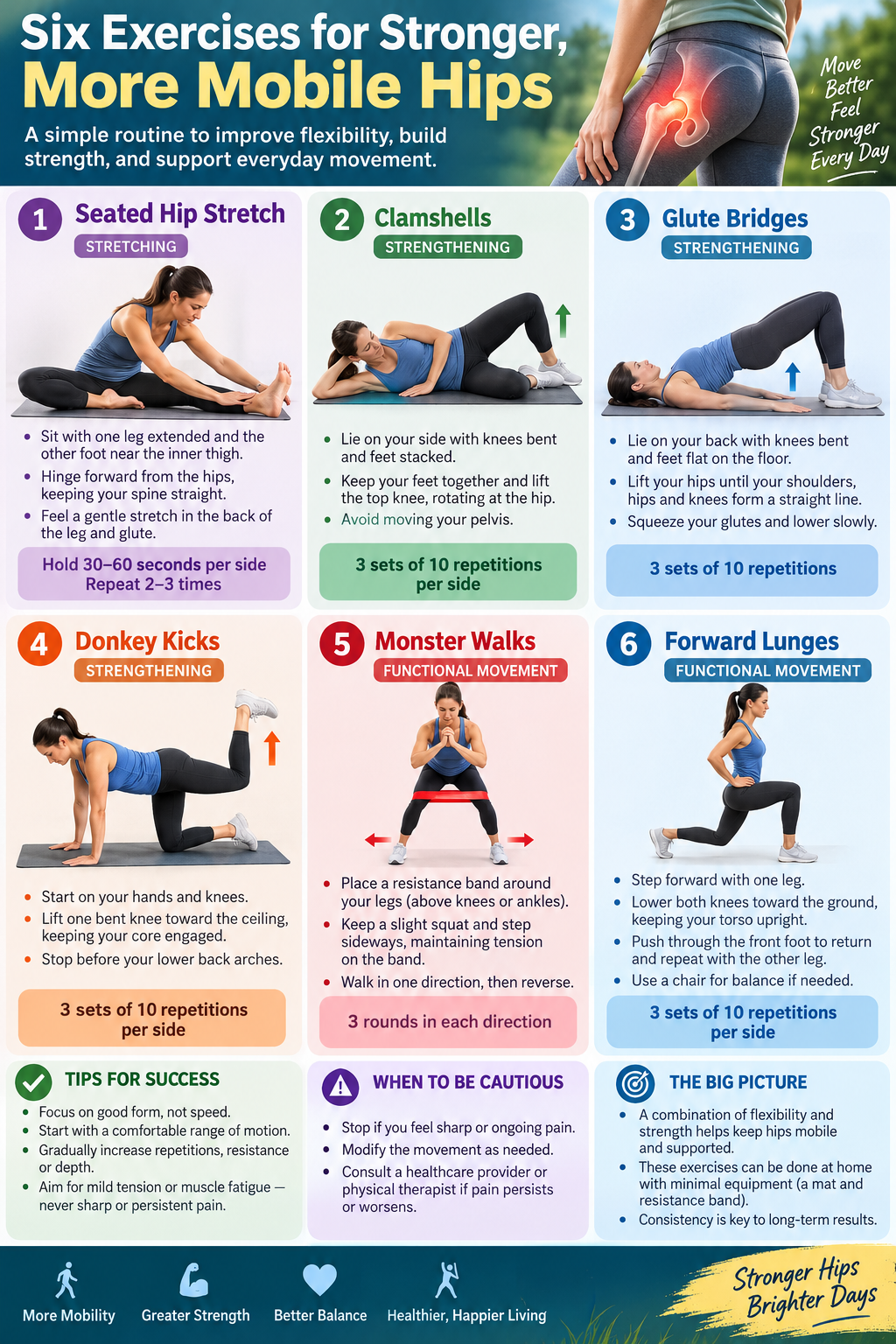
1. Seated Hip Stretch
A seated stretch is a simple way to begin working on flexibility around the hips, glutes and back of the legs.
Sit on the floor with one leg extended in front of you. Bend the opposite knee and place that foot near the inner thigh of the straight leg. Keeping your spine long, gently hinge forward from the hips toward the extended leg.
Move only until you feel a comfortable stretch. Avoid forcing your torso downward or rounding your back simply to increase the distance you can reach.
Hold the position for approximately 30 to 60 seconds, then switch sides. Repeat the stretch two to three times on each side.
Regular flexibility exercises may help maintain or improve range of motion around the joints, particularly when incorporated consistently into an overall exercise program [1]. Beginners can reduce the intensity by limiting how far they lean forward [2].
2. Clamshells
Clamshells target the muscles along the outside of the hip that help stabilize the pelvis during standing, walking and other lower-body movements.
Lie on one side with your knees bent and your legs stacked. Keep your feet together while slowly raising the top knee. The movement should come primarily from the hip rather than from twisting your pelvis or torso.
Pause briefly at the top before lowering the knee with control.
Aim for three sets of 10 repetitions on each side.
As the exercise becomes easier, a resistance band placed around the thighs can add additional resistance. However, maintaining proper form should take priority over increasing difficulty.
3. Glute Bridges
Strong gluteal muscles contribute to hip extension and play an important role in many everyday movements.
Begin by lying on your back with your knees bent and your feet flat on the floor. Engage your abdominal muscles and squeeze your glutes as you lift your hips.
At the top of the movement, your shoulders, hips and knees should form roughly a straight line. Avoid excessively arching the lower back.
Pause briefly before slowly lowering your hips to the floor.
Complete approximately three sets of 10 repetitions.
The lowering phase should remain controlled rather than allowing the hips to drop quickly. Bridging exercises are commonly incorporated into exercise programs designed to strengthen muscles involved in mobility and lower-body function [2].
4. Donkey Kicks
Donkey kicks provide another way to strengthen the glutes while practicing controlled hip extension.
Start on your hands and knees with your hands positioned beneath your shoulders and your knees beneath your hips.
Keeping one knee bent, slowly lift the leg upward and slightly backward. Keep your abdominal muscles engaged and your spine relatively neutral throughout the movement.
The goal is not to raise the leg as high as possible. Stop when further movement would require you to excessively arch or rotate your lower back.
Lower the leg slowly and repeat.
Perform approximately three sets of 10 repetitions on each side.
Controlled movement is particularly important because increasing range at the expense of proper alignment may shift the work away from the intended hip muscles [2].
5. Monster Walks
Monster walks introduce resistance and lateral movement into the routine.
Place a resistance band around your legs. Depending on your strength and the resistance level of the band, it may be positioned above the knees or lower on the legs.
Move into a shallow squat while keeping your chest upright. Step sideways while maintaining tension on the band. Follow with the opposite leg without allowing your feet to completely collapse together.
Continue stepping in one direction before reversing.
Complete approximately three rounds in each direction.
Resistance bands offer a convenient way to progressively increase muscular demand without requiring large pieces of exercise equipment [3].
6. Forward Lunges
Lunges combine hip mobility, leg strength, balance and coordination in a movement that resembles many activities performed in daily life.
Begin from a standing position and take a controlled step forward with one leg. Bend both knees as you lower your body toward the floor while keeping your torso upright.
Push through the front foot to return to the starting position and repeat with the opposite leg.
The depth of the lunge can be adjusted according to strength, balance and mobility. Beginners may perform a shallower lunge or hold the back of a sturdy chair for additional stability.
Lunges engage several major lower-body muscle groups, including the glutes, quadriceps and hamstrings, while taking the hip through a relatively large functional range of motion [4].
Why Both Mobility and Strength Matter
Improving hip function is not simply a matter of becoming more flexible. A joint also needs sufficient muscular support to control the range of motion available to it.
Occupational therapist Kevin Shelley has emphasized the importance of balancing stretching with muscle training, noting that flexibility without adequate strength may not provide the stability necessary for safe functional movement [5].
This makes the combination of stretching, strengthening and functional exercises particularly useful. The seated stretch addresses flexibility, while clamshells, bridges and donkey kicks focus on muscular support. Monster walks and lunges then challenge the body to use that mobility and strength during more dynamic movement patterns.
Progress Gradually
The quality of each repetition matters more than performing a large number of repetitions.
Start with a comfortable range of motion and increase the difficulty gradually. Progress might involve adding repetitions, using a stronger resistance band or increasing the depth of a movement.
Stretching may create mild tension, and strengthening exercises can produce muscular fatigue, but sharp, sudden or persistent pain should not be ignored.
Anyone experiencing ongoing hip pain, significant weakness or worsening symptoms should stop the exercise that causes discomfort and seek guidance from an appropriate healthcare professional or physical therapist.
A Simple Routine for Everyday Hip Health
These six exercises provide a practical combination of mobility and strengthening work:
- Seated hip stretch — improves flexibility.
- Clamshells — strengthen the lateral hip muscles.
- Glute bridges — develop glute and hip-extension strength.
- Donkey kicks — strengthen the glutes through controlled hip extension.
- Monster walks — challenge lateral hip stability using resistance.
- Forward lunges — integrate strength, mobility and balance into a functional movement.
Most of the routine requires nothing more than enough floor space to move comfortably. A mat may make floor exercises more comfortable, while a resistance band can be used for monster walks and more advanced variations of other exercises.
Consistency is more important than pushing for immediate results. When practiced with controlled technique and gradual progression, mobility and strengthening exercises can become part of a broader strategy for maintaining healthy, functional movement as people age.
References
- Mayo Clinic. Mayo Clinic on Healthy Aging.
- Debbie Lawrence and Louise Barnett. The Complete Guide to Exercise Referral: Working with Clients Referred to Exercise.
- Mercola.com. “What Are the Benefits of Using Resistance Bands?” February 28, 2020.
- NaturalNews.com. “Lunge Science: Five Exercises for Leg and Core Strength, as Outlined by Occupational Therapist Kevin Shelley.” August 28, 2026.
- NaturalNews.com. “5 Exercises That Aim to Balance Strength and Flexibility.” July 24, 2026.