




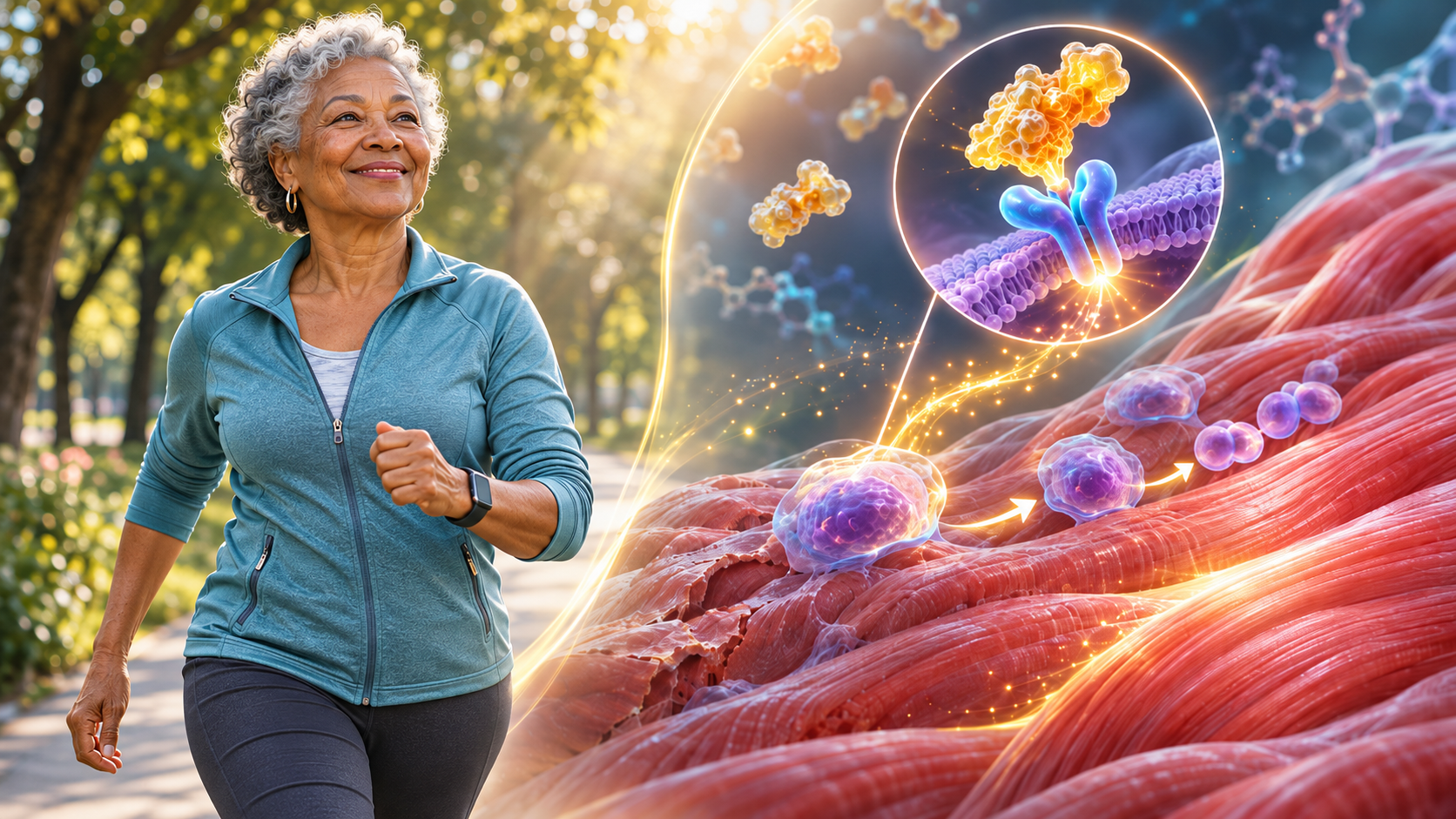
Japanese researchers have identified a compound that strengthens a natural muscle-repair signal, potentially opening a new direction in the fight against age-related muscle loss.
November 4, 2026 | VietEcho Health
Imagine reaching your seventies or eighties and finding that everyday activities, such as climbing stairs, carrying groceries, or getting out of a chair, are becoming increasingly difficult.
For millions of older adults, losing muscle strength can gradually affect their independence and quality of life.
But what if scientists could help the body’s natural muscle-repair system work more effectively?
Researchers at Kyushu University in Japan have discovered an intriguing way to strengthen a protein involved in muscle regeneration. Their findings, published in the scientific journal Scientific Reports, introduce a potentially enhanced form of the protein that researchers call “Super HGF.”
Although the discovery is still in its early stages, it may open new possibilities for understanding and eventually treating age-related muscle deterioration.
1. Why Do Our Muscles Become Weaker as We Age?
Our muscles do much more than help us exercise.
They allow us to walk, stand, maintain balance, lift objects, and perform ordinary daily activities.
As people age, muscle mass and strength often decline through a process associated with sarcopenia, a condition involving progressive loss of muscle mass, strength, and physical performance.
Several factors contribute to this decline, including reduced physical activity, changes in hormones, nutritional deficiencies, and alterations in the body’s ability to maintain and repair muscle tissue.
Aging muscles may also accumulate fat and fibrous tissue while losing some of the fast-contracting muscle fibers that help us perform powerful movements.
The consequences can be significant.
Reduced muscle strength may increase the risk of falls, limit mobility, and make recovering from illness or injury more difficult.
Scientists have therefore been investigating ways to preserve not only muscle mass but also the biological systems responsible for maintaining healthy muscle tissue.
2. The Body Has Its Own Muscle-Repair Team
One of the body’s remarkable abilities is repairing damaged muscle fibers.
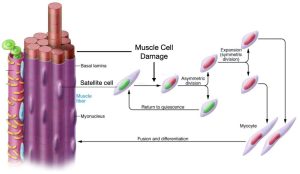
Much of this process depends on specialized stem cells called satellite cells.
These cells are located alongside skeletal muscle fibers and generally remain inactive until they receive signals that muscle repair is needed.
When activated, satellite cells can multiply and contribute to the repair and regeneration of muscle tissue.
An important protein involved in this process is hepatocyte growth factor (HGF).
Despite its name, HGF is not limited to the liver. It also plays an important role in activating the stem cells associated with skeletal muscle repair.
HGF communicates with satellite cells through a receptor called c-Met, located on their surfaces.
Think of HGF as a key and c-Met as a lock.
When the key fits the lock, it activates signals that help awaken the muscle’s repair cells.
But as muscles age, this communication system can become less effective.
3. Scientists Identify a Hidden Problem in Aging Muscles
Researchers have discovered that HGF can undergo a chemical change called nitration.
Nitration occurs when reactive molecules chemically modify certain parts of a protein.
In HGF, researchers identified two particularly important locations, known as Y198 and Y250, that are involved in its interaction with the c-Met receptor.
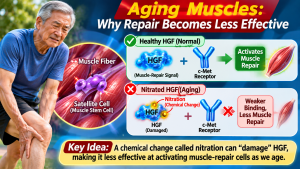
When these regions become chemically modified, HGF’s ability to bind to its receptor can decrease.
Imagine having the correct key for a lock, but the key has become slightly damaged.
The key still exists, but it may no longer work properly.
Similarly, aging muscle tissue may still contain HGF, but chemical alterations can interfere with its ability to activate muscle-repair cells.
Researchers believe this process may contribute to the declining regenerative capacity of aging muscles.
4. A Surprising Discovery: The Creation of “Super HGF”
The Japanese research team, led by Professor Ryuichi Tatsumi of Kyushu University, investigated whether certain sulfur-containing compounds could protect HGF against chemical damage.
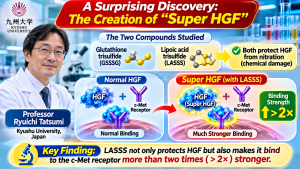
They examined two substances:
- Glutathione trisulfide (GSSSG)
- Lipoic acid trisulfide (LASSS)
Both compounds demonstrated an ability to protect HGF against nitration under laboratory conditions.
However, one compound produced an unexpected result.
When researchers exposed HGF to a higher relative amount of LASSS, they discovered that the protein’s ability to bind to the c-Met receptor increased substantially.
The receptor-binding affinity increased more than twofold compared with untreated HGF.
Even more interesting, LASSS-treated HGF showed greater resistance to the harmful effects of nitration.
Researchers began referring to this enhanced version as “Super HGF.”
The discovery suggests that LASSS may do more than protect proteins from chemical damage.
It may also interact with HGF in a way that changes its molecular structure, allowing the protein to attach more effectively to its receptor.
However, researchers have not yet established precisely how this interaction occurs.
Importantly, stronger receptor binding does not automatically mean that muscle strength or regeneration improves.
That remains a question for future experiments.
5. What Happened When Scientists Tested the Compound in Mice?
After observing the laboratory findings, researchers wanted to investigate whether LASSS could protect HGF inside living muscle tissue.
They conducted experiments involving mice subjected to reduced use of their hindlimbs.
This experimental approach helps scientists study biological changes associated with muscle inactivity and atrophy.
The results were encouraging.
Mice that received LASSS before the period of reduced muscle use showed less HGF nitration than untreated mice.
In other words, the compound appeared to protect an important muscle-repair protein from a form of chemical damage.
However, there is a critical distinction.
The experiments did not demonstrate that LASSS restored lost muscle mass, increased physical strength, or reversed muscle aging.
They showed protection of a protein involved in the repair process.
Researchers must still determine whether these molecular effects translate into meaningful improvements in muscle function.
6. Could This Discovery Help Older Adults?
If future studies confirm the findings, researchers may eventually explore treatments that support the body’s natural muscle-repair mechanisms.
Potential areas of investigation include age-related muscle deterioration, muscle weakness associated with prolonged inactivity, and impaired muscle regeneration.
For example, older adults who spend extended periods in bed during an illness can lose substantial muscle strength.
People recovering from injuries may also face challenges rebuilding muscle function.
A treatment capable of preserving or improving muscle-repair signaling could potentially become useful in these situations.
But this remains a long-term possibility, not an established medical treatment.
No human clinical trial in this study demonstrated that LASSS improves muscle strength, restores mobility, or treats sarcopenia.
Researchers must investigate its safety, appropriate dosing, long-term effects, and effectiveness in living organisms before considering clinical applications.
7. Does This Mean People Should Start Taking Lipoic Acid Supplements?
No.
Although the compound investigated in this study contains the words lipoic acid, LASSS is chemically distinct from ordinary alpha-lipoic acid supplements.
The research does not establish that taking commercially available alpha-lipoic acid products will enhance HGF or improve muscle regeneration.
In fact, the study found that ordinary lipoic acid did not reproduce the same receptor-binding enhancement observed with LASSS.
There is currently no evidence from this study supporting the use of LASSS or alpha-lipoic acid supplements to reverse age-related muscle loss in humans.
People should not interpret these preliminary findings as a recommendation to begin taking supplements.
8. What Can People Do Today to Help Preserve Muscle Strength?
While scientists continue investigating new treatments, there are established ways to support muscle health throughout aging.

Regular resistance exercise is among the most effective strategies for maintaining muscle strength and function. Activities may include appropriately supervised weight training, resistance bands, or exercises using body weight.
Adequate nutrition, including sufficient dietary protein and overall calorie intake, is also important for muscle maintenance.
Regular physical activity, such as walking and balance training, can help support mobility and reduce functional decline.
For individuals who already experience substantial weakness, difficulty walking, or recurrent falls, a healthcare professional or physical therapist can help determine appropriate interventions.
These approaches have considerably more clinical evidence supporting their benefits than the experimental compound examined in the new study.
9. What Comes Next?
The next challenge for researchers is determining whether the molecular advantages observed with LASSS can produce measurable improvements in muscle repair and strength.
Scientists will need to investigate several important questions.
Can the compound safely preserve muscle function in aging animals?
Does enhancing HGF signaling lead to better activation of muscle stem cells and improved regeneration?
And eventually, could a treatment based on this mechanism be safe and effective in humans?
Until these questions are answered, “Super HGF” remains an intriguing experimental discovery rather than a proven therapy.
10. A New Direction in the Science of Healthy Aging
Growing older does not mean losing all independence, but age-related muscle weakness can make daily life increasingly challenging.
For many older adults, maintaining the ability to walk, climb stairs, prepare meals, and participate in family activities is more important than achieving athletic strength.
The discovery from Kyushu University offers a new perspective on muscle aging.
Rather than focusing only on replacing lost muscle tissue, scientists are exploring how to protect and strengthen the biological signals that help muscles repair themselves.
Although much more research is necessary, understanding these signals could eventually contribute to new approaches for preserving mobility and independence.
The most promising aspect of this discovery is not that scientists have found a cure for muscle aging, but that they have identified another biological mechanism worth investigating.
And sometimes, a meaningful scientific breakthrough begins with understanding one small molecular interaction.
Scientific Sources
Original research: Zushi K., Seki M., et al. (2026). Enhanced HGF with increased receptor affinity and nitration-dysfunction resistance through interaction with lipoic acid trisulfide. Scientific Reports, 16, Article 22053.
DOI: https://doi.org/10.1038/s41598-026-60835-w
Research news: Kyushu University, November 4, 2026, via ScienceDaily.
https://www.sciencedaily.com/releases/2026/11/261104005226.htm
Medical Disclaimer
This article is provided for educational and informational purposes only and does not constitute medical advice, diagnosis, or treatment. The findings discussed are based on preliminary laboratory and animal research and should not be interpreted as evidence of an established human treatment. Always consult a qualified healthcare professional before making changes to medical care or starting supplements.
VietEcho — Your Health, Your Knowledge.