





Researchers have identified an abnormal brain rhythm that may help explain why schizophrenia affects perception, speech, movement, and the ability to interpret the world. The discovery could eventually open new possibilities for earlier detection and more targeted treatment.
VietEcho Health | October 29, 2026
What if several seemingly unrelated symptoms of schizophrenia were actually connected to a single problem in how the brain communicates?
Scientists at McGill University in Canada have discovered evidence suggesting that disrupted brain rhythms may play a common role in some of the most puzzling symptoms of this complex mental health condition.
The researchers identified weaker and slower beta-band brain activity among people diagnosed with schizophrenia.
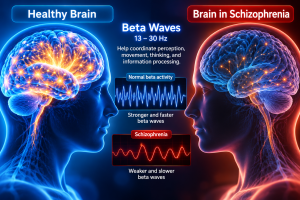
More importantly, abnormalities in this brain signal were associated with difficulties processing sensory information, disorganized speech, and greater overall symptom severity.
The findings, published in Science Advances in October 2026, could help researchers better understand how schizophrenia affects the brain.
Although the discovery is promising, it is still preliminary. The study involved only 50 participants, and more research is needed before the findings can be used for diagnosis or treatment.
What Is Schizophrenia?
Schizophrenia is a complex psychiatric disorder that can affect how a person perceives reality, processes information, communicates, and interacts with others.

It is often misunderstood by the general public.
Some people mistakenly believe schizophrenia means having multiple personalities. However, schizophrenia is not the same as dissociative identity disorder, a separate mental health condition.
People with schizophrenia may experience a combination of symptoms, including:
Hallucinations: Perceiving something that is not actually present, such as hearing voices when no one is speaking.
Delusions: Strongly held beliefs that are not supported by reality and persist despite contradictory evidence.
Disorganized speech: Difficulty organizing thoughts into clear and understandable communication.
Disorganized behavior: Actions that may appear unpredictable, confused, or poorly coordinated.
Reduced motivation and emotional expression: Difficulty initiating activities, maintaining social relationships, or expressing emotions.
Cognitive difficulties: Problems involving attention, working memory, planning, or processing information.
Not everyone with schizophrenia experiences the same symptoms or the same degree of impairment.
With appropriate treatment and support, many people can experience significant improvement and lead meaningful, productive lives.
The Brain Works Like an Orchestra
To understand the new discovery, imagine the human brain as a large orchestra.
Different sections must work together to produce music.
The violins, piano, drums, and other instruments may play different parts, but their timing must be coordinated.
If one section begins playing too slowly or falls out of rhythm, the entire performance can become disorganized.
The brain operates through a similarly complex coordination process.
Billions of nerve cells communicate through electrical and chemical signals.
Some of these signals form rhythmic patterns called brain oscillations, commonly known as brain waves.
These rhythms help coordinate communication among different brain regions.
When their timing or strength is disrupted, the brain may have difficulty combining information efficiently.
The McGill University researchers focused on one particular rhythm: beta-band activity.
What Are Beta Brain Waves?
Beta waves are rhythmic patterns of brain activity generally occurring at frequencies of approximately 13 to 30 hertz.
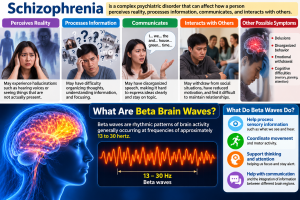
One hertz represents one cycle per second.
Beta activity is involved in several brain functions, including movement, sensory processing, attention, and the coordination of information.
However, beta waves do not simply represent intelligence or concentration. Their roles depend on the brain regions involved and the activity being performed.
In the new study, scientists examined how beta-band activity behaved while participants completed tasks involving perception and movement.
They discovered that people with schizophrenia tended to show weaker and slower beta activity than healthy comparison participants.
This finding suggests that changes in the brain’s internal timing mechanisms may contribute to several symptoms previously studied separately.
How Did Researchers Study the Brain?
The research involved 50 participants, divided into two groups:
- 25 people diagnosed with schizophrenia.
- 25 healthy comparison participants.
Researchers measured brain activity while participants performed tasks involving visual and auditory information.
These tasks tested how accurately people could perceive the timing of events involving sights and sounds.
Scientists also examined participants’ speech to assess patterns of disorganized communication.
The research team used a technology called magnetoencephalography, commonly abbreviated as MEG.
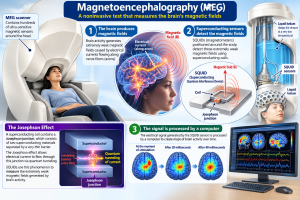
MEG detects extremely small magnetic fields produced by electrical activity in the brain.
Unlike conventional structural imaging, which primarily shows anatomy, MEG can measure changes in neural activity with very high temporal precision.
This allows researchers to investigate the timing of brain signals during different activities.
The measurements were conducted at the McConnell Brain Imaging Centre at the Montreal Neurological Institute-Hospital.
What Did the Scientists Discover?
The researchers found that beta-band brain activity was generally weaker and slower in participants with schizophrenia.
But the most interesting finding involved how those abnormalities related to different symptoms.
Participants with more pronounced beta-band abnormalities also tended to experience greater difficulties in several areas.
1. Difficulty Processing Sights and Sounds
Our brains constantly receive information from the eyes and ears.
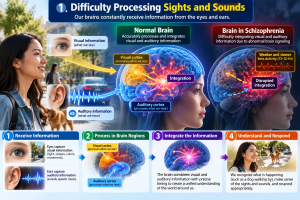
To understand the surrounding environment, the brain must determine when events occur and how different sensory signals relate to each other.
For example, when watching someone speak, the brain combines the movement of the person’s lips with the sound of their voice.
Accurate timing helps integrate these signals into a coherent experience.
If sensory timing becomes disrupted, interpreting incoming information may become more difficult.
The researchers found that weaker beta-band activity was associated with poorer performance on tasks involving sensory timing.
2. Disorganized Speech
Another important finding involved speech organization.

People with schizophrenia sometimes experience difficulty maintaining a logical sequence of ideas during conversation.
Their speech may shift unexpectedly between topics or become difficult for others to follow.
The researchers found that greater beta-band abnormalities were also associated with more pronounced speech disorganization.
This suggests that some mechanisms involved in coordinating sensory information may also relate to how the brain organizes language.
However, the study does not establish that abnormal beta waves directly cause speech difficulties.
3. Greater Symptom Severity
The investigators also examined the relationship between beta-band activity and overall clinical symptoms.
Participants with more pronounced abnormalities in this brain signal tended to have more severe symptoms.
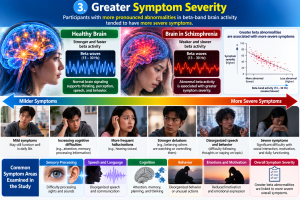
The association suggests that disrupted neural timing may reflect a broader disturbance in how the brain processes and coordinates information.
Importantly, the strength and reliability of these associations still need confirmation in larger studies.
Why Is This Discovery Different?
Schizophrenia affects multiple areas of brain function.
Traditionally, researchers have often examined sensory difficulties, speech disturbances, movement abnormalities, and other symptoms as separate problems.
The new findings raise the possibility that at least some of these difficulties share a common underlying mechanism.
Rather than viewing each symptom in isolation, researchers may be able to investigate how disruptions in brain-wide coordination contribute to several symptoms simultaneously.
This does not mean schizophrenia has only one cause.
The disorder involves a complex combination of genetic, neurodevelopmental, environmental, and biological factors.
Neurotransmitter systems, including dopamine and glutamate signaling, have also been extensively investigated.
The beta-band findings add another perspective to this complex picture rather than replacing existing scientific explanations.
Could This Lead to Earlier Detection of Schizophrenia?
One potentially important application involves identifying people who may need early mental health support.
Schizophrenia often begins to emerge during adolescence or early adulthood.
Before more recognizable psychotic symptoms develop, some individuals may experience changes in thinking, social functioning, motivation, or perception.
Recognizing concerning changes early can help people access appropriate professional evaluation and treatment.
Researchers hope that, if the findings are confirmed, measurements of beta-band brain activity might eventually contribute to identifying people at elevated risk of developing psychosis.
However, there are major limitations.
The present study did not establish a reliable screening test.
It did not demonstrate that beta-band activity can accurately predict which individuals will develop schizophrenia.
Nor did it establish that abnormal beta activity is unique to schizophrenia rather than occurring in other neurological or psychiatric conditions.
Larger, independent studies will be necessary before such measurements could be considered for routine clinical use.
Could Scientists Develop New Treatments?
Another question is whether the findings could eventually lead to more targeted treatments.
Current schizophrenia treatment often includes antipsychotic medication, psychological therapies, family education, social support, and rehabilitation services.
These approaches can help reduce symptoms and improve functioning, although responses vary among individuals.
If disrupted beta-band activity contributes to certain symptoms, future researchers might investigate methods of modifying these neural rhythms.
Potential research directions could include noninvasive brain stimulation or other interventions designed to influence neural communication.
However, these are possibilities for future investigation, not treatments validated by the new study.
There is currently no evidence from this research that simply strengthening beta waves would cure schizophrenia or eliminate its symptoms.
Why Early Support Matters
Schizophrenia can have a substantial effect on education, employment, relationships, and daily life.
Unfortunately, misunderstanding and stigma may discourage people from seeking help.
Some individuals and families may hesitate to discuss unusual perceptions, hearing voices, or significant changes in thinking because they fear judgment.
It is important to understand that schizophrenia is a medical and mental health condition, not a sign of personal weakness or moral failure.
Symptoms can be evaluated and treated by qualified mental health professionals.
Early assessment is especially important when someone begins experiencing persistent hallucinations, strongly held unusual beliefs, disorganized thinking, or major changes in behavior and functioning.
Such experiences do not automatically mean a person has schizophrenia, because several medical, neurological, psychiatric, and substance-related conditions can produce similar symptoms.
A thorough professional evaluation is necessary.
The Study’s Important Limitations
Although the discovery provides a potentially valuable research direction, several limitations must be considered.
First, the study was small. Only 25 participants with schizophrenia and 25 healthy comparison participants were included.
Second, the study identified associations. It did not prove that weaker beta-band activity directly causes the symptoms observed.
Third, the findings require independent replication. Scientists need to determine whether similar results appear in larger and more diverse populations.
Fourth, clinical applications remain uncertain. The research does not establish a new diagnostic test, screening method, or treatment.
The researchers themselves emphasized the need for additional studies before drawing stronger conclusions.
The Bottom Line
Scientists at McGill University have identified an intriguing connection between weaker, slower beta-band brain activity and several symptoms of schizophrenia.
The findings suggest that abnormalities in how the brain coordinates information may help explain difficulties involving sensory processing, speech organization, and overall symptom severity.
This research adds to our understanding of schizophrenia as a disorder involving complex neural communication processes.
If confirmed in larger studies, the discovery could eventually contribute to improved methods of understanding, detecting, or treating certain symptoms.
For now, the findings should be viewed as an important step in scientific research rather than a clinical breakthrough ready for immediate use.
The most encouraging message is that scientists are continuing to uncover how the brain works, bringing new understanding to conditions that have challenged medicine for generations.
Sources and References
Original Research: Wei HT, Boutet D, Dou R, Ahrens J, Zeramdini N, Voppel A, and colleagues. Neurophysiological dynamics related to perception, action, and language in schizophrenia. Science Advances. 2026;12(43).
DOI: https://doi.org/10.1126/sciadv.aeh5819
Research News: McGill University, published by ScienceDaily, October 29, 2026.
https://www.sciencedaily.com/releases/2026/10/261028232659.htm
VietEcho Health Disclaimer: This article is intended for educational purposes and does not replace professional medical or mental health evaluation, diagnosis, or treatment.