
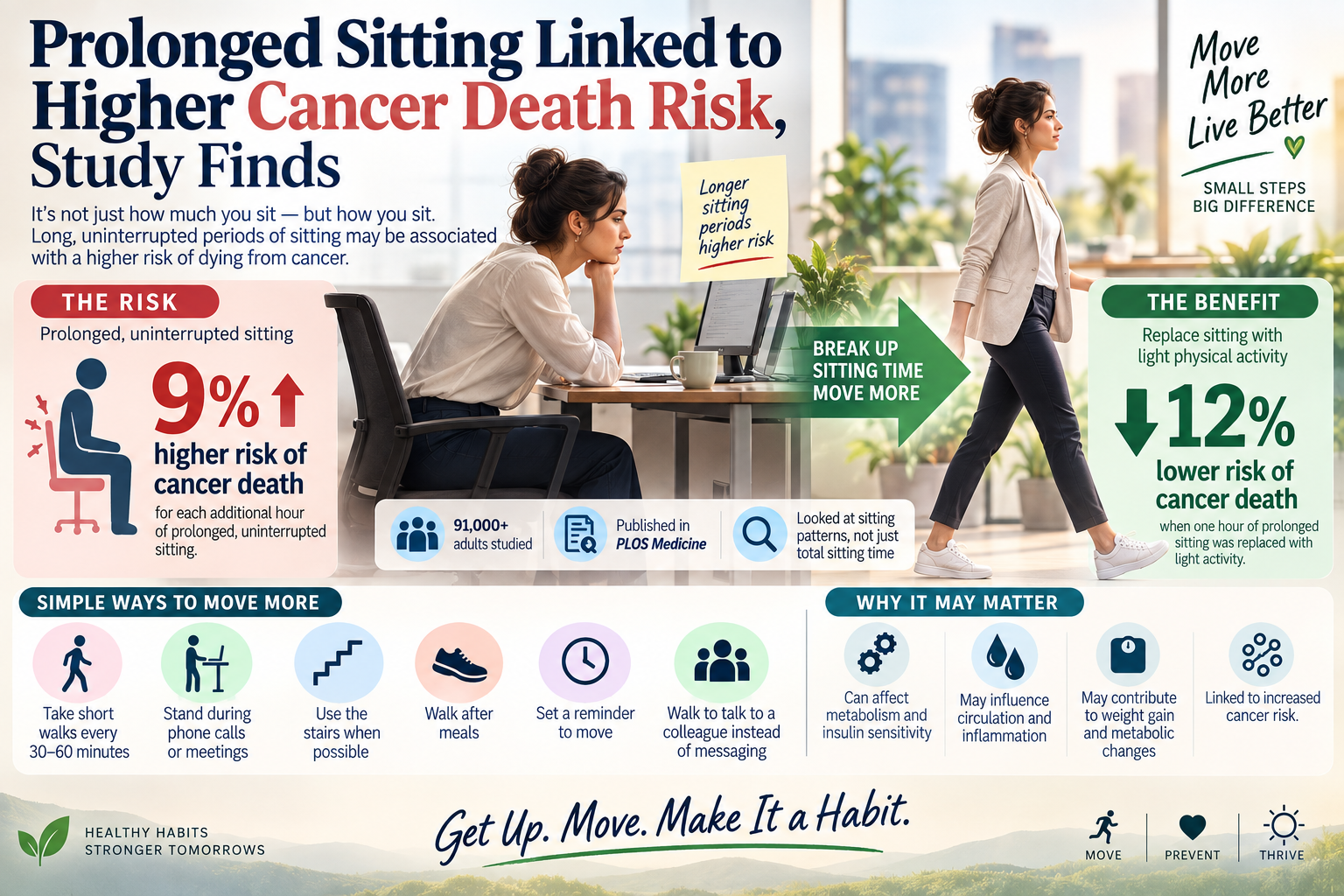
Spending long periods sitting without getting up may be associated with a higher risk of dying from cancer, according to a large observational study examining the relationship between sedentary behavior and cancer outcomes.
The research, published in PLOS Medicine, suggests that how sedentary time is accumulated may matter in addition to how much time people spend sitting overall. Researchers found that longer periods of uninterrupted sedentary behavior were associated with increased cancer mortality, highlighting another potential reason to incorporate regular movement into the day.
More than 91,000 adults were included in the analysis, allowing researchers to distinguish between total sedentary time and prolonged periods of sitting without movement.
Sitting for Long Periods May Matter
Sedentary behavior has previously been associated with several adverse health outcomes, including cardiovascular disease, Type 2 diabetes and premature mortality.
The new research examined a more specific question: Does sitting continuously for long stretches carry different risks than accumulating the same amount of sedentary time in shorter periods?
Researchers reported an association between prolonged sedentary bouts and cancer mortality. The findings suggest that extended periods without movement may provide information about health risk that total daily sitting time alone does not fully capture.
This distinction could have practical implications for people whose jobs require many hours at a desk.
Instead of focusing exclusively on reducing total sitting time, regularly interrupting sedentary periods with movement could become another useful target for healthier daily routines.
Replacing Sedentary Time With Movement
One of the most encouraging findings concerned what might happen when sedentary time is replaced with physical activity.
Statistical modeling suggested that replacing periods of prolonged sitting with light-intensity activity was associated with lower cancer mortality.
Light activity does not necessarily mean going to the gym or completing an intense workout. Walking around the office, performing household tasks, standing and moving during breaks, or taking a short walk can all increase daily movement.
Other research has similarly associated higher daily step counts with lower risks of several adverse health outcomes, including cardiovascular disease and premature death.
Studies examining physical activity and cancer have also reported associations between greater activity levels and lower risks for certain cancers.
Together, the evidence reinforces an increasingly important message: movement accumulated throughout the day matters.
Why Might Prolonged Sitting Affect Health?
Researchers have proposed several possible biological mechanisms connecting sedentary behavior with chronic disease.
Long periods of inactivity can influence glucose regulation, insulin sensitivity, circulation and energy expenditure. Sedentary lifestyles may also contribute indirectly to weight gain and metabolic dysfunction.
These factors are relevant because obesity, insulin resistance and chronic metabolic abnormalities have been associated with increased risks for several cancers.
Physical movement, even at relatively low intensity, activates muscles and changes how the body processes glucose and fats.
Regularly getting out of a chair could therefore produce metabolic effects that are not necessarily captured by a single exercise session performed earlier or later in the day.
However, scientists are still investigating exactly how patterns of sedentary behavior influence cancer development and mortality.
Exercise May Not Tell the Whole Story
Someone can meet recommended exercise targets and still spend much of the remaining day sitting.
For example, a person might exercise for 30 or 45 minutes in the morning but subsequently spend eight hours working at a computer and several more hours sitting in a car or watching television.
This has led researchers to examine sedentary behavior as a health factor distinct from insufficient exercise.
The emerging message is not that structured exercise is ineffective. Regular moderate-to-vigorous physical activity remains an important component of good health.
Instead, exercise and sedentary behavior may represent two different parts of the same picture.
A useful daily routine could therefore combine regular exercise with frequent opportunities for light movement throughout the day.
What the Study Cannot Prove
An important limitation is that this type of research is observational.
Researchers can identify associations between prolonged sedentary behavior and cancer outcomes, but they cannot conclude from those associations alone that uninterrupted sitting directly causes cancer or cancer death.
People who spend long periods sedentary may differ from more active people in numerous other ways, including diet, body composition, metabolic health, occupation, smoking history or underlying illness.
Researchers attempt to adjust statistically for many of these differences, but it is impossible to eliminate every potential confounding factor.
The findings should therefore be interpreted as evidence of an association rather than proof of cause and effect.
Small Movement Breaks Can Add Up
For people who spend much of their day at a computer, reducing uninterrupted sitting does not necessarily require major lifestyle changes.
Simple strategies include:
- Standing or walking briefly between meetings.
- Taking short movement breaks during extended periods of desk work.
- Walking while making phone calls when practical.
- Taking a brief walk after meals.
- Using stairs when appropriate.
- Walking to speak with a colleague rather than sending a message.
- Alternating between sitting and standing when the work environment allows it.
The objective is not to remain standing continuously. Standing still for extremely long periods can create its own discomfort and health concerns.
Instead, the emphasis should be on changing positions and moving regularly.
Sitting Is Only One Part of Cancer Risk
Cancer is a complex group of diseases influenced by genetics, aging, environmental exposures and numerous behavioral factors.
Sedentary behavior should therefore not be viewed in isolation.
Maintaining a healthy body weight, exercising regularly, avoiding tobacco, limiting alcohol, eating a nutritious diet, obtaining recommended vaccinations and participating in appropriate cancer screening remain important components of cancer prevention.
Breaking up sitting periods can complement these strategies rather than replace them.
The Bottom Line
Large-scale observational research suggests that spending extended periods sitting without movement may be associated with greater cancer mortality risk.
Perhaps more importantly, replacing some sedentary time with physical activity—even relatively light movement—may be associated with better health outcomes.
The research does not prove that prolonged sitting directly causes cancer or that simply standing up at specific intervals will prevent it. More research is needed to determine whether deliberately interrupting sedentary periods produces measurable reductions in cancer incidence or mortality.
Still, the findings reinforce a practical principle with benefits extending well beyond cancer prevention:
Sit less when possible, interrupt long periods of inactivity, and find opportunities to move throughout the day.
For people whose work requires hours at a desk, small and consistent movement breaks may be one of the simplest ways to build more physical activity into everyday life.