

For millions of people, the artificial-intelligence (now called super-intelligence) boom appears on a laptop or smartphone screen.
Ask a chatbot a question. Generate an image. Summarize a document. Write some computer code.
But behind that simple text box sits an increasingly enormous physical economy.
Semiconductors. Servers. Data centers. Networking equipment. Electricity. Cooling systems. Power transmission.
And developments on Tuesday, October 6, offered another glimpse of just how large that economy is becoming.
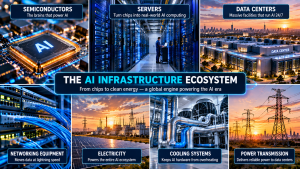
French artificial-intelligence company Mistral announced a new AI model as it competes in an increasingly crowded global market. At almost the same time, chipmaker AMD said it plans to substantially increase chip supply in 2027 to meet booming AI demand, while semiconductor company Marvell Technology raised its fiscal 2028 revenue forecast to approximately $20 billion, citing demand for custom data-center chips. Reuters
These may appear to be three separate corporate stories.
They aren’t.
Together, they illustrate the expanding economic machinery underneath the AI revolution.
Mistral and Europe’s Bid for a Bigger Role in AI
France’s Mistral AI announced a new artificial-intelligence model Tuesday, adding another competitor to the increasingly international race to build powerful AI systems.

Mistral says its newest system outperforms some Chinese open-weight models in certain areas. The announcement comes as European technology companies seek a larger role in an industry currently dominated by major American and Chinese players. Reuters
That competition matters for more than technological prestige.
Countries and companies increasingly view AI capability as an economic and strategic asset. Businesses want access to powerful models, governments are thinking about technological sovereignty, and developers want alternatives that can be deployed for different languages, industries and regulatory environments.
The result is no longer simply a competition to build the “smartest chatbot.”
It is becoming a competition to build entire AI ecosystems.
Every Powerful AI Model Needs Something Physical
AI can feel almost weightless.
You type words into a browser and an answer appears seconds later.
But AI computation occurs on physical machines.
Large numbers of specialized processors operate inside data centers, connected by sophisticated networking equipment. Those processors require electricity. They generate heat and therefore require cooling. Data must move between machines rapidly enough that thousands of processors can work together.
That means every major expansion in AI eventually creates demand somewhere else in the economy.
More AI → more computing → more chips → more servers → more data centers → more electricity and infrastructure.
That chain helps explain why semiconductor companies have become some of the biggest financial beneficiaries of the AI boom.
AMD Says It Needs More Chips
AMD CEO Lisa Su said Tuesday that the company plans to substantially increase its chip supply in 2027 as it responds to booming artificial-intelligence demand.
AMD is one of Nvidia’s most important competitors in processors used for AI computing and has been rapidly expanding its AI business. Reuters
The significance isn’t simply that AMD wants to sell more processors.
Manufacturing advanced chips requires an enormous global supply chain involving semiconductor fabrication, advanced packaging, memory, substrates and other components.
So when demand for AI accelerators rises sharply, pressure can spread throughout that supply chain.
And the race is not confined to the familiar GPU market.
Marvell Shows Another Side of the AI Chip Boom
Marvell Technology provides another important piece of the story.

The company raised its fiscal 2028 revenue forecast Tuesday to approximately $20 billion, compared with the $18 billion forecast it had issued in August. Analysts surveyed by LSEG had expected about $18.2 billion.
Marvell attributed the stronger outlook to growing demand for chips used in AI data centers, particularly custom silicon. Its shares jumped in early trading following the announcement. Reuters
Custom chips are becoming increasingly important because some giant cloud and technology companies don’t want to rely exclusively on general-purpose AI accelerators.
They want processors designed around their own workloads.
That creates another potentially enormous semiconductor market alongside conventional GPUs.
The Data Center Is Becoming an AI Factory
A useful way to understand the shift is to stop thinking about data centers merely as buildings that store websites and files.
The newest AI facilities increasingly resemble computational factories.
Instead of turning steel into automobiles or crude oil into gasoline, these facilities turn enormous quantities of electricity and computing power into digital intelligence.
Inside them, thousands of processors can work together to train or operate AI models.
That requires high-speed networking, enormous amounts of memory, sophisticated cooling and reliable electricity around the clock.
And that physical infrastructure is expensive.
Major technology companies have committed extraordinary sums to expanding AI and cloud capacity. Earlier Reuters analysis estimated Microsoft, Amazon, Meta and Alphabet planned roughly $630 billion in capital spending during 2026, much of it associated with scaling data-center and AI infrastructure. Reuters
And Then There Is Electricity
Perhaps the least visible part of the AI boom is electricity.

A chatbot may live in “the cloud,” but the cloud plugs into the electrical grid.
Rapid data-center expansion is increasing electricity demand in several U.S. markets. During the summer of 2026, growing data-center consumption joined extreme heat and air-conditioning demand in putting additional pressure on power systems.
Reuters analysis published Tuesday found that renewable generation—particularly solar, wind and battery-supported resources—supplied much of the additional electricity demand across several major U.S. markets during that period. Reuters
That means the AI race is beginning to intersect directly with another enormous economic transformation:
the modernization of the electric grid.
Future AI growth may therefore depend not only on who can design the fastest processor, but also on who can secure electricity, build transmission, add generation capacity and cool enormous computing facilities efficiently.
Wall Street Is Paying Attention

Investors certainly understand the scale of the opportunity.
The S&P 500 and technology-heavy Nasdaq reached record highs Tuesday as Treasury yields eased and investors continued looking toward the coming earnings season. AI enthusiasm has been an important force behind technology-stock gains. Reuters
But enormous expectations create enormous risks.
Building AI infrastructure requires extraordinary amounts of capital. Companies are investing today based partly on assumptions about how much businesses and consumers will eventually pay for AI services.
If demand grows as rapidly as expected, today’s infrastructure spending could create one of the largest technology markets in history.
If revenue fails to catch up with investment, however, some expensive facilities and investments could produce disappointing returns.
That is why the financial side of AI deserves as much attention as the technological side.
A Global Competition Is Taking Shape
The AI race increasingly has several layers.
There is a model race involving companies building increasingly capable artificial-intelligence systems.
There is a chip race involving Nvidia, AMD, custom silicon and specialized semiconductor companies.
There is a data-center race among cloud providers and infrastructure developers.
There is an energy race to supply those facilities.
And increasingly, there is a national competition among the United States, China, Europe and other regions seeking control over strategically important technology.
Mistral’s latest announcement is therefore just one piece of a much larger transformation.
The Real AI Revolution May Be Happening Behind the Screen
Consumers will continue to experience artificial intelligence through chatbots, image generators, autonomous agents and increasingly capable software.
But investors, businesses and governments are discovering that the real AI economy extends much farther.
It reaches semiconductor factories.
It reaches server racks.
It reaches power plants and transmission lines.
It reaches enormous data centers being built around the world.
And it reaches financial markets allocating hundreds of billions of dollars toward the expectation that AI will become a fundamental part of the global economy.
The chatbot may be what we see.
The infrastructure behind it may ultimately be the bigger story.