
Hubble’s 200,000th Orbit Comes With a Cosmic Waiting Game
A star exploded billions of years ago. Astronomers have already seen its light—and now they are waiting to see it again.
NASA’s Hubble Space Telescope reached its 200,000th orbit around Earth on September 19, 2026. One of its observations around that milestone focused on a distant supernova called Athena, whose light may return to view between now and early March 2027.
How can one explosion appear twice?
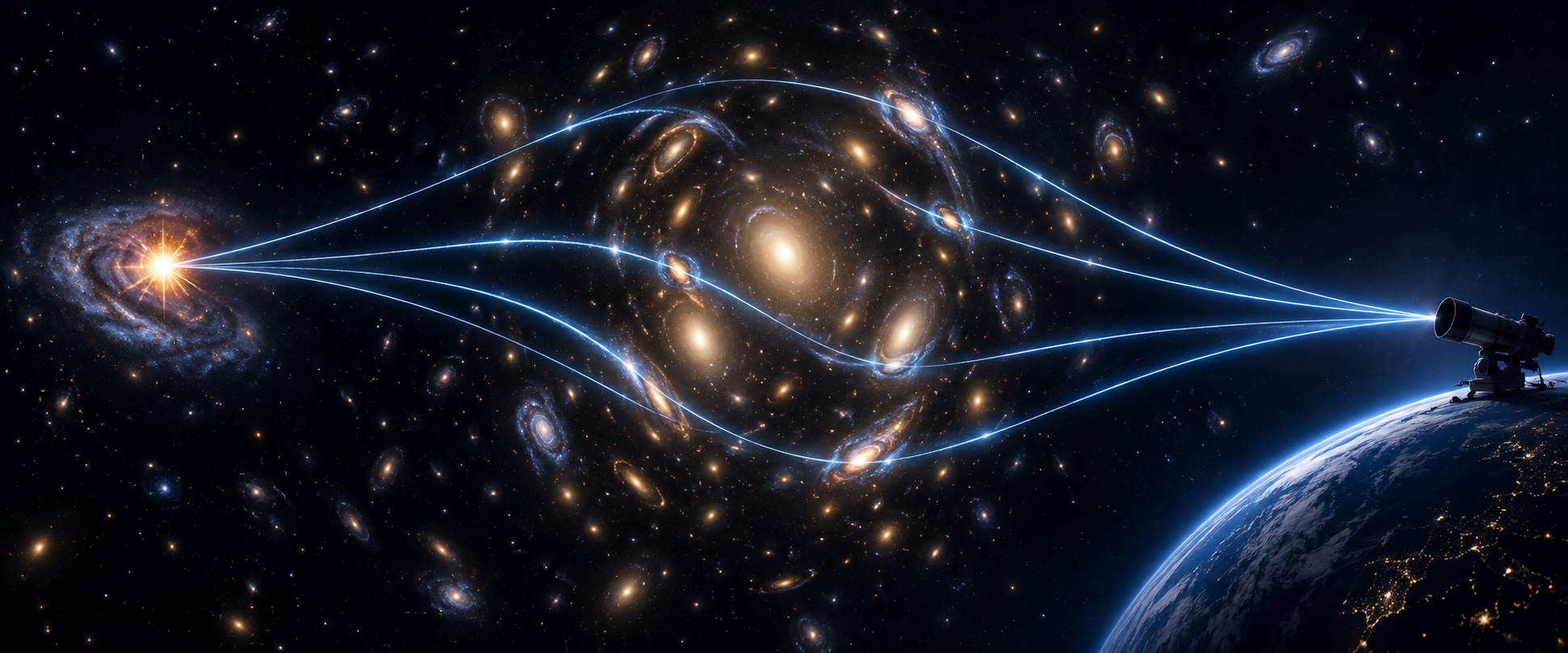
Between Earth and Athena sits an enormous cluster of galaxies called MACS J0417. Its gravity bends the light traveling from objects behind it, acting like a natural cosmic lens.
Light from the same explosion can take different routes around the cluster. One route may reach us before another, producing separate images of an event that happened only once. Astronomers call this gravitational lensing.
NASA’s James Webb Space Telescope discovered Athena in 2025. Hubble is now revisiting the region to look for its predicted reappearance. The timing is uncertain: scientists have not announced that the supernova has appeared again.
Why the wait matters
If Athena does reappear, the delay between its images could give researchers another way to study the gravity—and therefore the distribution of mass—within MACS J0417.
Those measurements could also help refine estimates of how fast the universe is expanding. This is careful measurement work, not a promise that one observation will settle every question about cosmic expansion.
The search highlights something Hubble does especially well: it can return to the same patch of sky repeatedly and compare what has changed. Webb and Hubble bring different strengths to the task, with Hubble observing visible and ultraviolet light while Webb is especially powerful in infrared.
A telescope still at work
Hubble has spent more than 36 years in space. NASA says it has traveled over 5 billion miles around Earth and made more than 1.7 million observations. Demand for its observing time remains high.
Its 200,000th orbit is an impressive number. Athena’s possible return is a reminder of why the telescope keeps circling: sometimes the most revealing image is the one scientists must patiently wait to take.