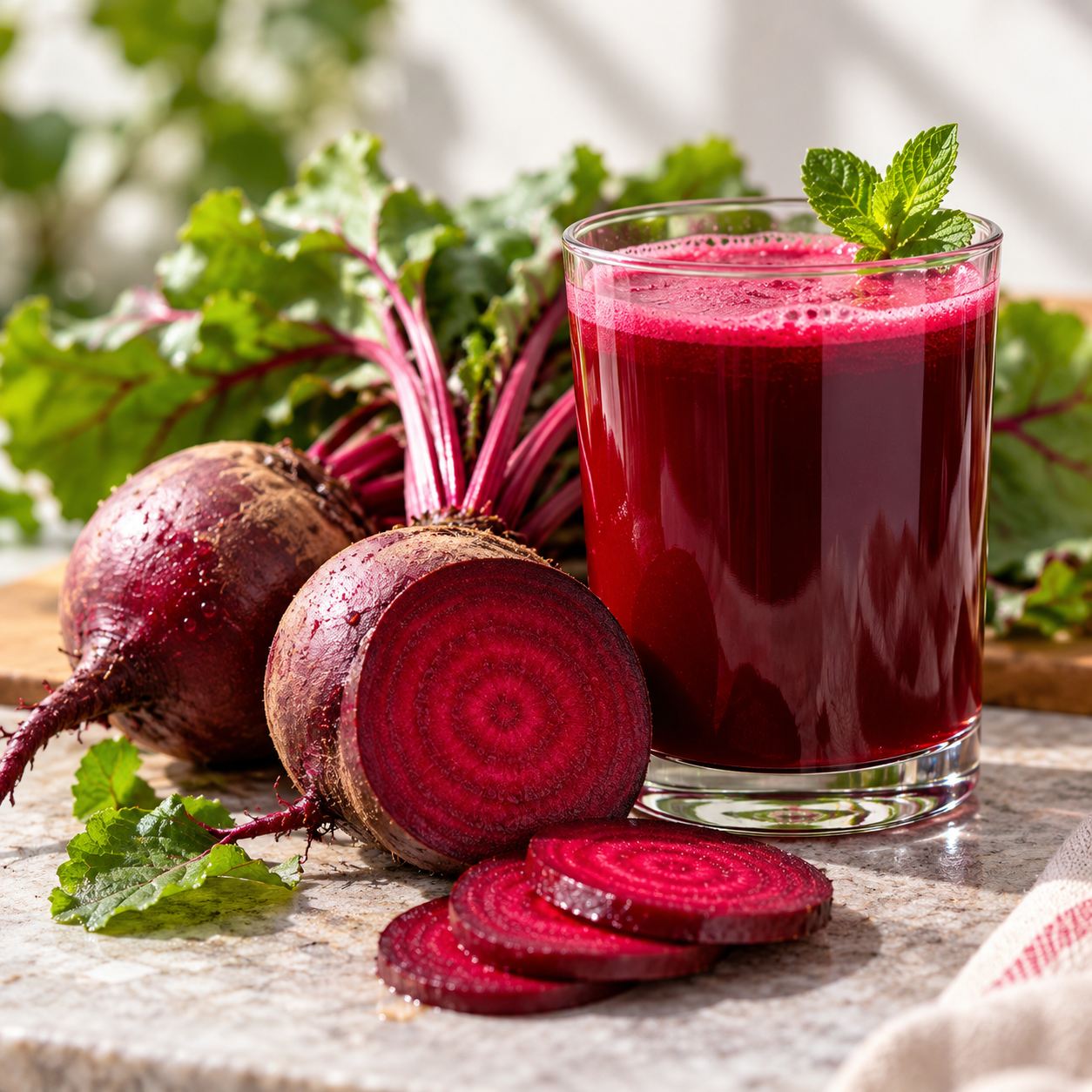
A deep crimson glass of beetroot juice may offer more than vibrant color and an earthy flavor. Increasing scientific interest suggests that beetroot juice could play a useful role in supporting cardiovascular health, particularly by helping to lower blood pressure.
The reason lies largely in beetroot’s naturally high concentration of dietary nitrate. Once consumed, nitrate is converted through biological processes into nitric oxide, a signaling molecule that helps blood vessels relax and widen. This process, known as vasodilation, can improve blood flow and reduce the resistance against which the heart must pump.
For people with hypertension, even relatively small improvements in blood pressure can be meaningful over time. However, beetroot juice should be viewed as a complementary dietary strategy rather than a replacement for medication, exercise, dietary changes, or medical care.
How nitrate supports blood-vessel function
Beetroot is one of the richest commonly consumed dietary sources of nitrate. After ingestion, nitrate is converted first to nitrite and ultimately to nitric oxide.
Nitric oxide plays an important role in regulating vascular tone. By signaling the smooth muscle surrounding blood vessels to relax, it allows the vessels to dilate. Wider, more relaxed arteries can reduce vascular resistance and potentially lower blood pressure.
This nitrate–nitrite–nitric oxide pathway is one of the principal reasons researchers have investigated beetroot juice for cardiovascular health and exercise performance.
What clinical research suggests
Clinical studies have generally found that nitrate-rich beetroot juice can produce modest reductions in blood pressure, although the magnitude of the effect varies considerably among individuals and studies.
One recent study published in Nutrition Research reported that daily beetroot juice concentrate consumption for three weeks was associated with a reduction of approximately 1.3 mmHg in systolic blood pressure compared with a control beverage.
Interestingly, researchers also examined participants after supplementation had ended. Some benefits remained detectable in blood-pressure measurements taken at home, although the findings were not consistently reflected in 24-hour ambulatory measurements.
The distinction is important. It suggests that beetroot juice may influence everyday blood-pressure regulation, but more research is needed to determine how persistent and clinically significant these effects are.
Looking at the broader evidence
Individual studies provide only part of the picture. Meta-analyses combining results from multiple clinical trials have also investigated the relationship between beetroot juice and blood pressure.
One analysis of 22 trials reported an average reduction of approximately 3.55 mmHg in systolic blood pressure and 1.32 mmHg in diastolic blood pressure following beetroot juice supplementation.
These changes may appear small, but modest reductions in blood pressure can still be meaningful when considered as part of a broader cardiovascular-risk reduction strategy.
The research also suggests that factors such as nitrate dose, duration of supplementation, baseline blood pressure, age, diet, and individual physiology may influence the response.
How much beetroot juice is needed?
There is currently no universally established therapeutic dose of beetroot juice for hypertension.
Clinical studies have used widely varying quantities, ranging from concentrated shots of around 70 mL to several hundred milliliters of juice per day. Because nitrate concentrations also differ substantially among products, the volume of juice alone does not necessarily indicate the effective dose.
For this reason, consumers considering commercial beetroot products should pay attention to their nitrate content rather than assuming that every beet juice or beet powder provides the same cardiovascular effect.
Products containing large amounts of added sugar should also be approached cautiously, particularly when the goal is improving metabolic and cardiovascular health.
Some blood-pressure effects may occur within several hours of consuming dietary nitrate, while longer studies investigate whether consistent daily consumption produces more sustained benefits.
Beetroot juice is an addition—not a replacement
Despite promising findings, beetroot juice should not be regarded as a natural substitute for prescribed hypertension treatment.
Blood pressure is influenced by numerous factors, including sodium intake, body weight, physical activity, sleep, stress, smoking, alcohol consumption, kidney function, genetics and underlying medical conditions.
The greatest benefit is therefore likely to come when beetroot juice is incorporated into a broader heart-healthy lifestyle rather than used in isolation.
People already taking antihypertensive medications should discuss regular high-nitrate supplementation with their healthcare professional. Combining medication with additional blood-pressure-lowering strategies could, in some individuals, contribute to excessively low blood pressure and symptoms such as dizziness or fainting.
Safety considerations
For most people, beetroot consumed as part of a normal diet is generally well tolerated.
One particularly noticeable but harmless effect is beeturia, in which urine or stools temporarily develop a pink or reddish color after eating beets or drinking beetroot juice.
Another consideration is oxalate. Beets contain oxalates, so people with a history of certain kidney stones—particularly calcium oxalate stones—may need to moderate concentrated beetroot consumption and discuss it with their healthcare professional.
Dietary nitrate also deserves some clarification. Concerns surrounding nitrates have historically been associated largely with processed meats and the potential formation of harmful N-nitroso compounds under certain conditions.
Vegetables provide nitrate within a very different nutritional environment. Beetroot and other nitrate-rich vegetables also contain antioxidants and other phytochemicals, making it inappropriate to treat vegetable-derived nitrate as nutritionally equivalent to nitrate or nitrite exposure from processed meats.
A promising tool for cardiovascular health
Beetroot juice represents an interesting example of how ordinary foods can influence human physiology.
Its nitrate content supports the production of nitric oxide, which can improve vascular function and may produce modest reductions in blood pressure. Clinical trials and meta-analyses provide encouraging evidence, but the results should be interpreted realistically: beetroot juice is not a cure for hypertension.
Instead, it may serve as one component of a comprehensive approach that includes appropriate medical treatment, regular physical activity, healthy weight management, adequate sleep and a diet rich in vegetables, fruits, whole grains and other minimally processed foods.
The science behind this crimson drink is promising precisely because it does not require extravagant claims. A simple root vegetable may offer a measurable cardiovascular benefit—and when incorporated thoughtfully into an evidence-based lifestyle, even modest improvements can matter.