




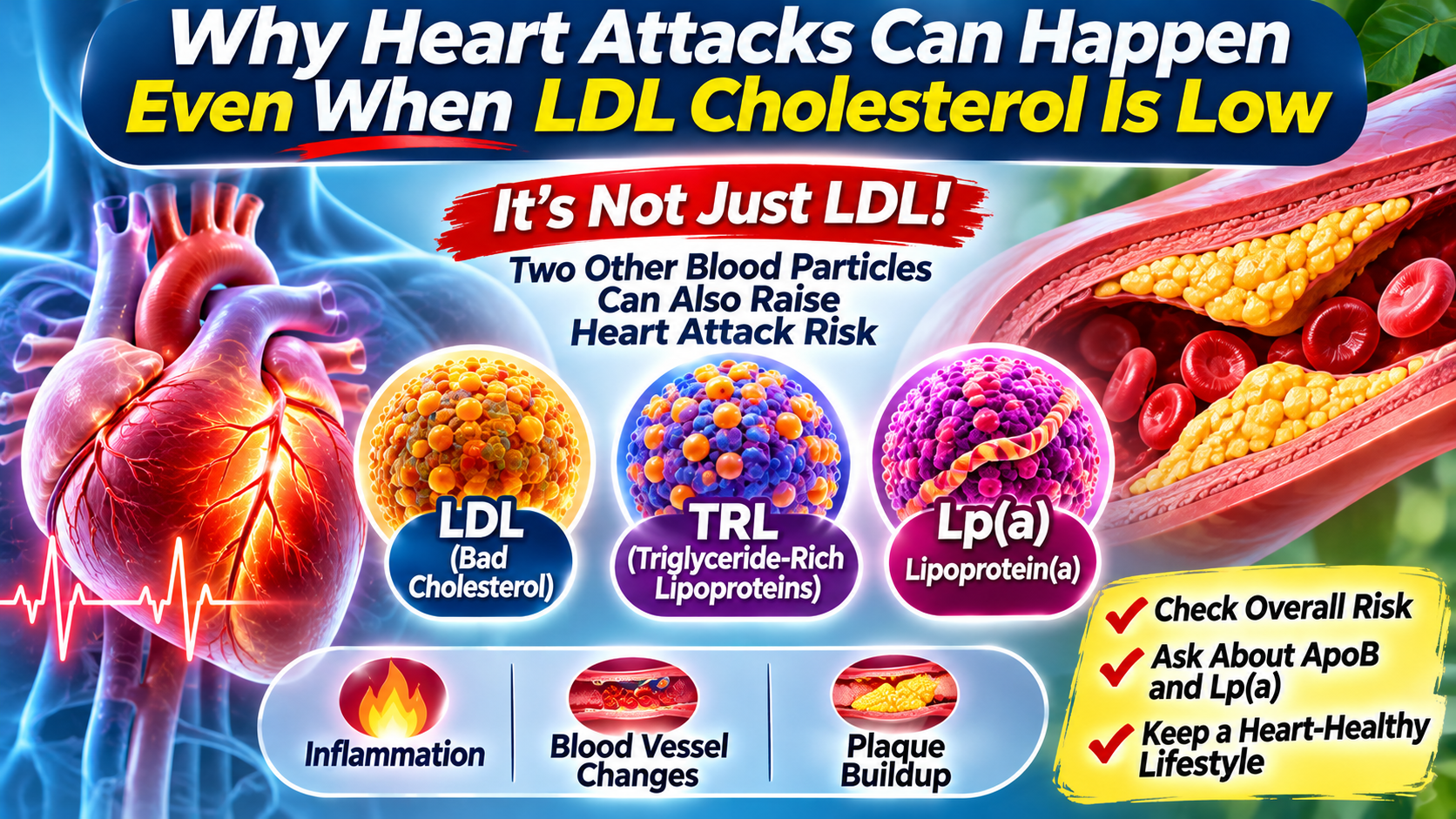
A major study involving approximately 35,000 people reveals why controlling LDL cholesterol may not eliminate the risk of heart disease—and identifies two other blood particles that could play an important role.
Many people believe that keeping their LDL cholesterol low is enough to protect them from a heart attack.
After all, LDL is commonly called “bad cholesterol,” and doctors have emphasized the importance of lowering it for decades.
But what happens when someone maintains healthy LDL levels and still develops coronary artery disease?
Scientists at Chalmers University of Technology in Sweden may have uncovered an important part of the answer.
Their research, published in the European Heart Journal and highlighted in November 2026, suggests that two other types of fat-carrying particles in the bloodstream may contribute to heart disease through inflammation and changes in blood vessel function.
The findings could eventually help doctors identify cardiovascular risks that traditional cholesterol measurements do not fully capture.
1. Why Lowering LDL Cholesterol Is Important—but Not Always Enough
Cholesterol is a waxy, fat-like substance that the body needs to build cell membranes and produce certain hormones.
Because cholesterol cannot travel freely through the bloodstream, it is transported inside particles called lipoproteins.
One of these particles is low-density lipoprotein, or LDL.
When too many LDL particles circulate in the blood, they can enter artery walls and contribute to the formation of fatty deposits called atherosclerotic plaques.
Over time, these plaques may narrow blood vessels and reduce blood flow.
If a plaque ruptures or erodes, a blood clot can form and suddenly block a coronary artery, potentially causing a heart attack.
Decades of research have established that lowering LDL cholesterol reduces cardiovascular risk.
However, some people continue to develop heart disease even after their LDL cholesterol reaches recommended levels.
Scientists call this remaining danger residual cardiovascular risk.
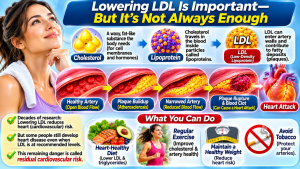
The new study offers clues about why that risk persists.
2. Researchers Studied Approximately 35,000 People
An international research team led by scientists at Chalmers University of Technology examined blood samples from approximately 35,000 participants in the UK Biobank who had no previous history of heart disease.
Using an advanced laboratory technique called proteomics, researchers analyzed nearly 3,000 proteins in blood samples.
They combined this information with genetic data and long-term health records.
Their goal was to understand how different fat-carrying particles influence biological processes associated with coronary artery disease.
The scientists focused on three major types of particles:
- Low-density lipoproteins (LDL)
- Triglyceride-rich lipoproteins (TRL)
- Lipoprotein(a), commonly abbreviated Lp(a)
All three contain a structural protein called apolipoprotein B, or ApoB.
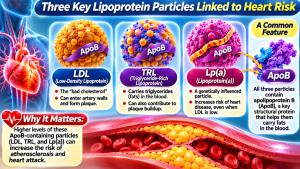
Although these particles can contribute to cholesterol accumulation in artery walls, the study suggests they may also influence cardiovascular disease through different biological pathways.
3. Two Other Particles May Help Explain the Hidden Risk
Triglyceride-Rich Lipoproteins (TRL)
Triglycerides are fats that the body uses for energy storage and transportation.
Triglyceride-rich lipoproteins carry these fats through the bloodstream.
As triglycerides are removed, some of the remaining particles become cholesterol-rich remnants capable of entering artery walls.
The new research suggests that TRL-related processes may also influence inflammation and the structure of blood vessels.
This is important because inflammation contributes to the development and progression of atherosclerosis.
Lipoprotein(a), or Lp(a)
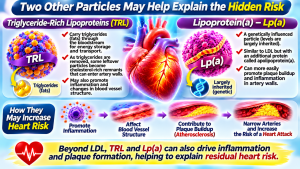
Lipoprotein(a) resembles LDL but contains an additional protein called apolipoprotein(a).
High Lp(a) levels are an established risk factor for cardiovascular disease.
Unlike LDL cholesterol, which is strongly influenced by diet, medications, and lifestyle, Lp(a) concentrations are largely determined by genetics.
A person may therefore have a favorable LDL cholesterol level but still carry elevated Lp(a).
The study identified biological patterns associated with Lp(a) that may contribute to cardiovascular risk beyond the amount of cholesterol carried by the particle.
4. The Surprising Connection: Inflammation
One of the most interesting discoveries involved similarities between the biological effects associated with TRL and Lp(a).
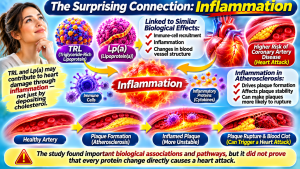
Researchers identified overlapping blood-protein patterns linked to these particles and to subsequent coronary heart disease.
Some of these patterns involved proteins associated with immune-cell recruitment, inflammation, and changes in blood vessel structure.
This suggests that the particles may contribute to cardiovascular damage through mechanisms that extend beyond simply depositing cholesterol.
Inflammation plays a central role in atherosclerosis.
When inflammatory cells enter an artery wall, they can contribute to plaque formation and influence plaque stability.
Some plaques become vulnerable to rupture, which can trigger clot formation and a heart attack.
The new findings suggest that TRL and Lp(a) may influence some of these processes.
However, the study primarily identified biological associations and pathways. It did not prove that every protein change directly causes a heart attack.
5. Why a Normal Cholesterol Test May Not Tell the Whole Story
A standard lipid panel commonly measures total cholesterol, LDL cholesterol, HDL cholesterol, and triglycerides.
These measurements provide valuable information about cardiovascular health.
However, they do not directly reveal every type of lipoprotein particle or every biological process contributing to atherosclerosis.
For example, someone could have:
- LDL cholesterol within the recommended range
- Elevated Lp(a)
- Increased numbers of ApoB-containing particles
- Insulin resistance or diabetes
- High blood pressure
- Chronic inflammatory conditions
- A strong family history of premature cardiovascular disease
These factors may contribute to cardiovascular risk even when LDL cholesterol appears well controlled.
The new research reinforces the importance of evaluating overall cardiovascular risk rather than relying on a single laboratory number.
6. Should People Ask About ApoB and Lp(a) Testing?
For some individuals, additional blood tests may provide useful information.
Apolipoprotein B (ApoB) reflects the number of circulating atherogenic lipoprotein particles, including LDL and other cholesterol-carrying particles.
ApoB testing may be particularly useful when LDL cholesterol does not accurately reflect particle-related risk, such as in certain people with elevated triglycerides or metabolic disease.
Lipoprotein(a) testing measures a largely inherited cardiovascular risk factor.
Many professional guidelines support measuring Lp(a) at least once during adulthood, particularly when cardiovascular risk assessment could benefit from the information.
Individuals with premature cardiovascular disease or a strong family history may have additional reasons to discuss testing with their healthcare professionals.
However, not everyone requires repeated advanced lipid testing.
The decision should depend on individual risk factors and medical history.
7. Does This Mean LDL-Lowering Medications Are Not Effective?
No. This distinction is extremely important.
The study does not challenge the established benefits of lowering LDL cholesterol.
Statins and other LDL-lowering therapies have been shown to reduce heart attacks and other cardiovascular events.
The new findings suggest that additional biological pathways may contribute to risk even after LDL cholesterol is controlled.
In other words, lowering LDL remains essential, but it may not address every cause of cardiovascular disease.
Researchers hope that understanding these additional pathways will eventually lead to more personalized prevention strategies.
8. What Can People Do to Protect Their Hearts?
Although the findings may lead to new diagnostic approaches or treatments, established cardiovascular prevention strategies remain important.
Maintain Healthy Cholesterol Levels
Follow individualized LDL cholesterol goals and take prescribed medications as directed.
Monitor Blood Pressure
High blood pressure damages blood vessels and increases the risk of heart attack, stroke, and heart failure.
Stay Physically Active
Regular physical activity improves cardiovascular fitness, blood pressure, insulin sensitivity, and several other risk factors.
Choose Heart-Healthy Foods
Dietary patterns rich in vegetables, fruits, whole grains, legumes, nuts, and unsaturated fats can support cardiovascular health.
Limiting excessive saturated fat intake may also help reduce LDL cholesterol.
Avoid Tobacco
Smoking damages blood vessels, promotes inflammation, and substantially increases cardiovascular risk.
Consider Family History
People with close relatives who experienced heart attacks or other cardiovascular events at unusually young ages may benefit from additional risk assessment.
9. Could This Research Lead to Better Treatments?
The findings identify biological pathways that scientists may investigate as future therapeutic targets.
If researchers can determine which inflammatory or vascular processes are most important, it may become possible to develop treatments that complement existing cholesterol-lowering medications.
The research could also help improve risk prediction by identifying people whose cardiovascular risk is not fully captured by standard LDL measurements.
However, these possibilities remain under investigation.
The study did not test a new treatment or establish a new blood-protein screening test for routine clinical use.
Additional research is necessary to determine whether targeting the identified pathways improves patient outcomes.
10. The Bottom Line: Low LDL Does Not Mean Zero Heart Attack Risk
The new research highlights an important message about cardiovascular health.
LDL cholesterol is a major risk factor for coronary artery disease, and lowering it remains one of the most effective ways to prevent heart attacks.
However, it is not the only factor.
Triglyceride-rich lipoproteins and lipoprotein(a) may contribute to cardiovascular disease through overlapping inflammatory and blood vessel pathways.
By studying nearly 3,000 blood proteins in approximately 35,000 participants, researchers have identified new clues about these processes.
The discovery may eventually help doctors provide more precise and personalized cardiovascular prevention.
The takeaway is simple: A healthy LDL cholesterol level is good news—but it does not guarantee that your arteries are free from disease.
Understanding your overall cardiovascular risk remains essential.
Scientific References
Morze J, et al. Apolipoprotein B-containing lipoproteins: distinct roles in atherosclerosis revealed by plasma proteomic profiling. European Heart Journal. 2026.
DOI: https://doi.org/10.1093/eurheartj/ehag718
Chalmers University of Technology. Beyond “bad” cholesterol: new clues to the risk of heart disease. October 13, 2026.
Medical disclaimer: This article is intended for educational purposes only and does not replace professional medical advice, diagnosis, or treatment. Do not stop or change prescribed cholesterol medications without consulting your healthcare professional.